(category)General
PMS as MF Wrapper: Testing the RIA AlternativePMS as MF Wrapper: Testing the RIA Alternative
PMS has real advantages and the RIA structure has its own. But the assumption that RIAs are uniformly cheaper than PMS for HNI MF portfolios doesn't survive the math. Read on to know more.
Akanksha Maulik•

The good thing about the ongoing dialogue on PMS as an MF wrapper is that it makes us, as PMS providers, introspect and take every argument seriously, analyse it, and see if we're on the right side of our fiduciary duties.
Before we step into the maths of PMS as MF wrapper vs RIA, there are two perspectives that I think need some clarification. The first is the argument that DIY is better. This is an apples-to-oranges comparison. We're talking about different client personas here; the ones fit for PMS are typically not fit for DIY.
Another argument was that PMSs advise to keep funds invested in India. This stance doesn't reflect the actual advisory conversations between PMS managers and their clients.
With these out of the way, let’s get to the point :
One strong argument was to use RIAs instead, as they charge a fixed fee. We looked into this, and the numbers aren’t exactly on expected lines.
Caveats :
- We're comparing fees, not services. The argument is whether to execute MFs through an RIA for clients who prefer advisor-led services.
- The fee paid to underlying direct MFs is common to both PMS and RIA structures, so that cancels out in our calculations.
- At Capitalmind PMS, we offer MF baskets at as low as 0.5% p.a. This may not be reflective of all PMSs. Our analysis is based on the fee we offer on MF baskets.
- Advisory is implicit in PMS relationships and PMSs such as us do goal-based planning based on varying risk appetites and investment horizons for clients at no additional cost.
Okay, with that context set, this is what we found when we did the math:
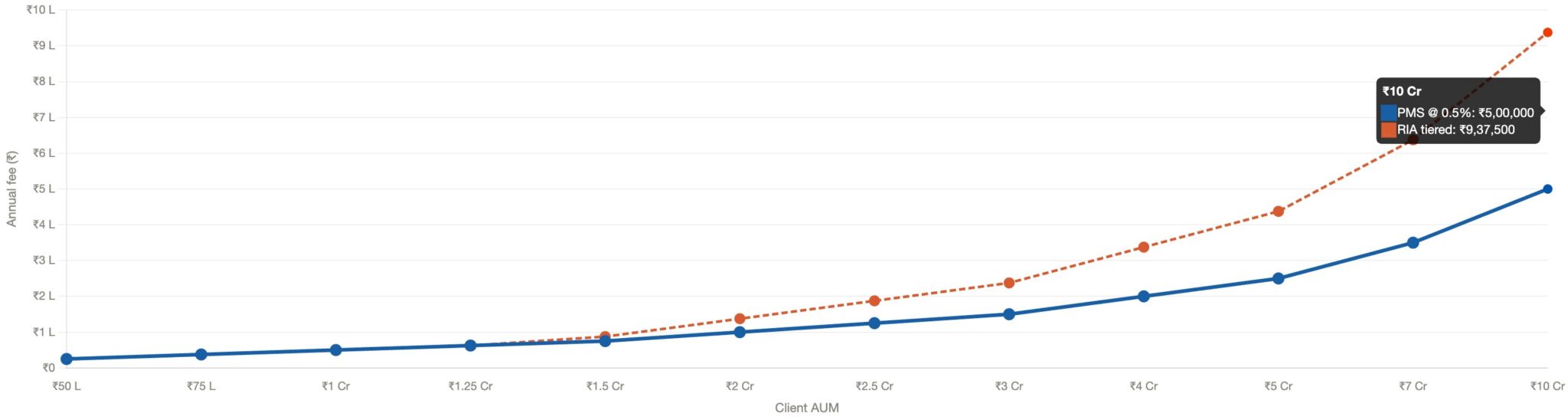
The RIA fee is capped at INR 1.51 lakh fixed, OR up to 2.5% of AUA per annum, the maximum limit as per SEBI's January 2025 master circular. The RIA typically picks whichever model pays them more, and they're allowed to switch anytime.
Let’s put this in perspective.
At INR 3 crore AUM, PMS at 0.5% fee structure works out to be INR 1.5 lakh in management fees - effectively the SEBI fixed-fee cap. This is the theoretical parity point. If the RIA were operating in fixed-fee mode, both structures would charge the same.
But INR 3 crore clients don't typically see fixed-model pricing. RIAs serving HNI clients at this size adopt a % of AUA pricing model, where the cap is 2.5% and typical pricing sits between 0.75% and 1.5% of AUA. A rational RIA flips their fee model the moment client AUA × their rate exceeds the fixed cap of INR 1.5 lakh.
At INR 3 crore, an RIA charging 1% of AUA (the lower end of the typical pricing) bills the client INR 3 lakh. PMS at 0.5% of AUM bills the client INR 1.5 lakh. A PMS like ours is typically at half the cost for INR3 crore level of assets.
Above INR 3 crore, the gap widens linearly. PMS scales at 0.5% of AUM. AUA-based pricing model RIA typically scales at 1% or higher. So, a INR 5 crore client would pay INR 2.5 lakh in PMS vs INR 5 lakh in RIA model. A INR 10 crore client would pay INR 5 lakh in PMS vs INR 10 lakh in a RIA model. Over five years at INR 10 crore AUM, that's a INR 25 lakh difference on fees alone, and that’s without factoring in AUM growth, which compounds it further.
Let's stress-test this with the friendliest possible assumption. Assume the RIA tier-matches PMS, charging 0.5% on the first INR 1.25 crore, and only 1% on incremental AUM above. This is more generous than most fee-only RIAs in the market.
Even then:
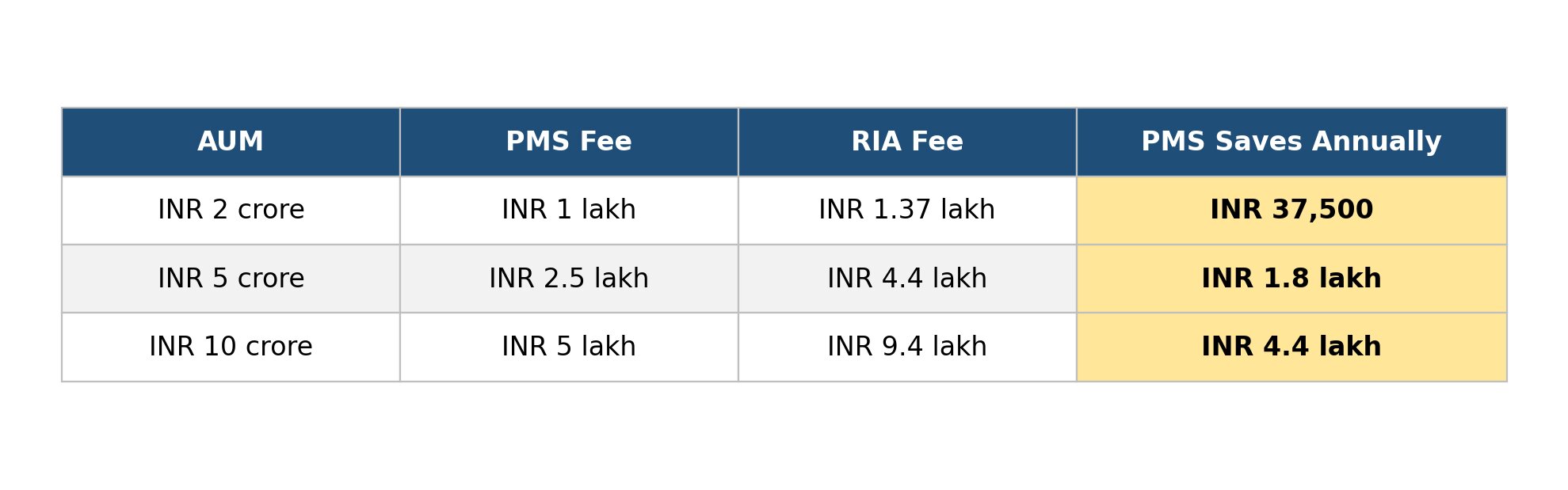
Still, PMS is more cost-effective by a margin that compounds with portfolio size.
There's one more scenario worth running, though, because it's the one place a fee-only RIA structure could beat PMS on cost.
Some RIAs use deeper tiered pricing—for instance, 1% / 0.75% / 0.5% / 0.25% across progressively larger AUM slabs. The blended rate falls as the portfolio grows.
For INR 10 crore+ portfolios under such a structure, blended advisory cost can dip below PMS's 0.5%. At INR 20-25 crore, blended can sit in the 0.35-0.40% range— meaningfully below PMS. On the advisory fee alone, this is real.
But this is where we have to be honest about what an actual ultra-HNI portfolio under an RIA looks like. At INR 10 crore+, RIAs don't typically keep clients in MFs alone. They allocate across PMS, AIFs, structured products, direct equity—each carrying its own management fee on top of the RIA's advisory fee.
And here’s the behavioural truth : Pure MF advisory at this scale is hard for an RIA to justify annual recurring fee. They have to raise an invoice each quarter, and the client writes a cheque out of pocket. The visible fee creates pressure to demonstrate product complexity, not because anyone necessarily asks for it, but because an invoice demands justification.
So a real ultra-HNI portfolio under an RIA tends to look like:
0.35% RIA advisory on the full corpus + 1.5-2% on the PMS sleeve (lesser if it is Capitalmind) + 1.5-2% on the AIF sleeve.
Stack it up and the client's all-in cost crosses 1.5% comfortably—three times the 0.5%.
A PMS, on the contrary, gets more cost effective. For large AUM clients, PMSs offer MF portfolios at 0.25%, too, instead of 0.5% as the revenue from 25bps in absolute terms is enough to manage a large AUM MF basket.
The deep-tier scenario where RIA blended cost falls below PMS holds only if the RIA keeps the entire portfolio in MFs. At that AUM, they typically don't.
The truth is, the fee table doesn't capture everything.
PMS has real advantages it doesn't show: LTCG harvesting at unit level, end-to-end execution, and the flexibility to hold a combination of MFs and stocks within the same portfolio.
The RIA structure has its own: a simpler regulatory profile, no ₹50 lakh minimum, a fee-only fiduciary framing that some clients specifically want, and wider asset coverage.
The fee comparison is but one input. Service fit, advisor trust, performance, behavioural handholding, favourable friction for exit, and tax structuring matter at least as much.
We aren't arguing PMS is always the better choice. For clients below INR 50 lakh, or those who explicitly want fee-only advisory plus DIY MF execution, an RIA can be the right fit.
But the assumption that RIAs are uniformly cheaper than PMS for HNI MF portfolios doesn't survive the math. In the INR 3-10 crore band—where most of our serious client conversations happen—a PMS at 0.5% is the cheaper structure, typically by 2x. And at INR 10 crore+, where one might assume deeper RIA tiers tilt the math the other way, the actual portfolio composition under an RIA—with PMS and AIF sleeves stacked underneath the advisory fee—pulls the all-in cost back above PMS.
Related Posts
 You Don’t Live Through Averages
Aaryan Sanghavi
 Inside Japan's 1980s Asset Price Bubble: The Lost Decades
Anoop Vijaykumar
 The Yield Frontier: Profiting from G-Sec & Sensex Yield Dynamics
Krishna Appala
 Happy Diwali 2025! More Useless Predictions Even Though...
Deepak Shenoy
Make your money work as hard as you do.
Talk to a Capitalmind Client AdvisorInvesting is not one size fits all
Learn more about our distinct investment strategies and how they fit into your portfolio.
Learn more about our portfoliosUnlock your wealth potential
Start your journey today