(category)General
Are You Holding an Underperforming Mutual Fund?Are You Holding an Underperforming Mutual Fund?
Diversification is only half the job. Read on to know where active management adds value, where index funds make sense, and why a disciplined fund selection process matters.
Sahil Jain•

Love a Bangalore winter all you want, the monsoon still turns up in June, and a wardrobe of only sweaters will let you down about eight months a year. So you keep linen, wool, and an umbrella, and stop pretending you get a vote on the weather.
Most equity portfolios haven't made that peace. Everyone nods along at "diversify across market caps." Then they go home to a portfolio piled into large caps because those feel safe, or crammed into mid and small caps because someone's cousin doubled their money after COVID. Both are a wardrobe built for one season, worn in the hope it never changes.
The argument for diversification comes from a very specific place. Mid and small lead when the mood is risk-on and large caps hold the floor when it turns risk-off. But nobody gets a memo about which regime is coming next, so owning all three stops you from betting the house on one regime lasting forever.
So we tested if this holds up as an actual strategy or if it is as generic as it sounds. Nothing exotic: We simply took Nifty 100, Nifty Midcap 150 and Nifty Smallcap 250, put a third of the money in each and rebalanced once a year. Over 20+ years, that equal-weighted mix compounded at 14.47% a year against the Nifty 500's 12.88%. The 1.6% alpha per year was generated by simply spreading the investment equally across market segments instead of holding the entire market as a single passive investment.
So "what to own" is basically settled: own all three. Next up, should you invest in low-cost index funds or an active fund trying to beat it?
Index or Active? Depends on the Market Segment.
The backtest above used vanilla indices because we were testing performance of each market segment, not the possibility of alpha from active fund management. So we ran another backtest, comparing the benchmark index with the average active fund in that category. No cherry-picking a winner with the benefit of hindsight, just the return of the typical fund.
Here's what we found, going back to 2013.
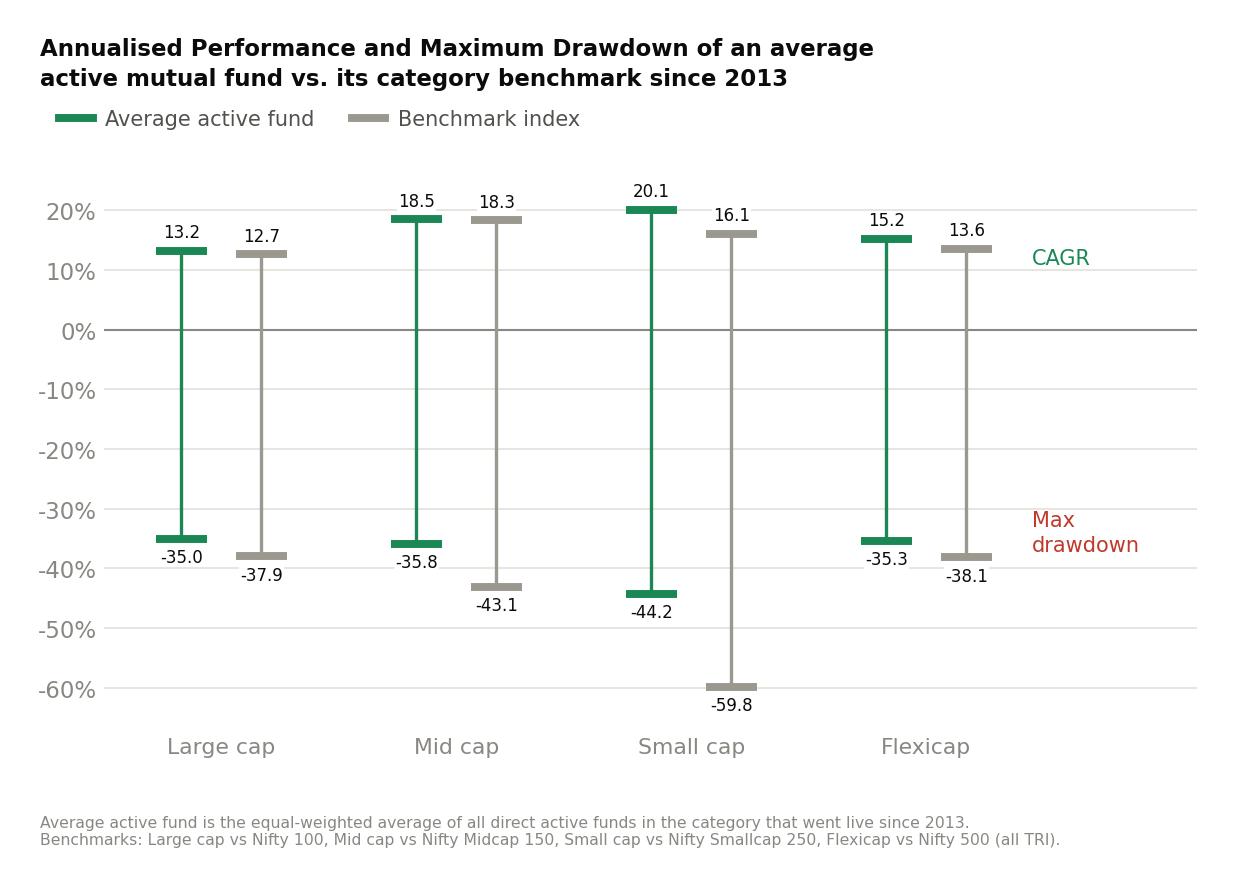
Large caps: The average fund had a wafer-thin edge on both returns and drawdown. When the average edge is this small, why pay up and take the selection risk?
Mid caps: The average fund basically delivered the same return but with ~7% lower drawdown vs. Nifty Midcap 150. Same destination but a smoother road. You're paid in calmer nerves rather than fatter returns and in mid caps that's a trade maybe worth taking.
Small caps: The average fund beat the benchmark with 4% higher CAGR while also falling ~15% less compared to Nifty Smallcap 250 — the sort of thing that earns a manager genuine regard. Small caps are chaotic enough that someone who steps around the worst of the wreckage adds real value.
Flexi cap: The average fund generated 1.6% alpha above the Nifty 500 making a case that an average active flexi cap fund has outperformed the broader index by timing the allocation across market caps to some extent.
One idea ties all four together. Be active only where there's something to be active about. Large caps are researched by every analyst in the country and priced efficiently, so funds bunch up around the index and there's very little room to add value. Walk down the size curve and the dispersion widens. The gap between a good fund and a mediocre one grows, and manager skill starts to earn its fee. There's a cost angle on top of that. A large-cap index fund charges a fraction of what an active one does, so in that segment you'd be paying up for an edge that barely shows in the data. That's the case for indexing your large-cap allocation and spending your active budget in mid, small, and flexi cap where there's actual alpha to chase.
But Here’s the Catch
You'd think the job is done: Index the large caps, buy the average active fund for the rest and go make chai.
But there's a catch you can't design your way around. You can't buy "the average fund." To earn the average return of a category we showed above, you'd have to own every fund in the category which, let's be sane, nobody does. In the real world you pick one. And the moment you pick, you're in the game S&P keeps a score of. As per the S&P Index Versus Active (SPIVA) India Scorecard, a large share of active funds trail the index over three and five-year windows.
So we checked what percentage of active funds underperform their benchmark on a rolling three-year basis more than 50% of the time. Basically, what are the odds you'd have picked a persistent laggard:
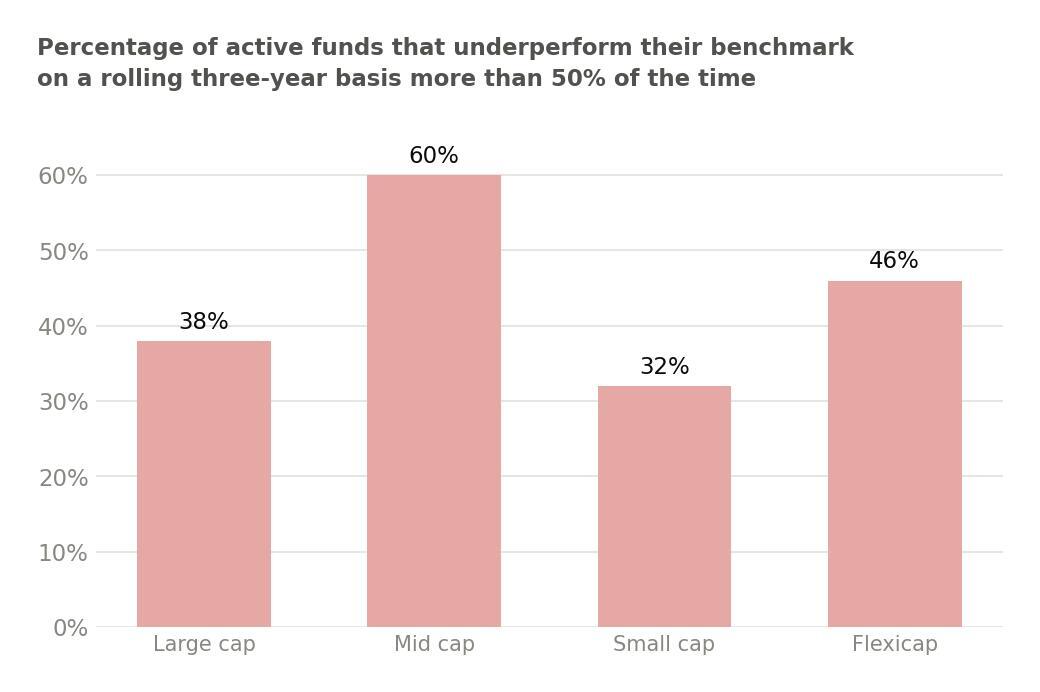
This data is the whole reason this article exists. In every category, a large share of funds spent at least half their time trailing their own benchmark. And we aren't talking about obscure funds or AMCs; they're ordinary funds that a sensible person could have easily picked. The average fund in the category may beat the index but many funds in the category may still underperform the index. The reason is simple: a handful of strong funds drag the category average up while most of the pack quietly trails behind.
Mutual Fund Investing Needs a System, Not a Blind Buy-and-Hold
Owning the average fund is fine in a spreadsheet. In real life you hold a handful of specific funds and some of them will quietly drift into the laggard pile and stay there. The problem isn't that active management doesn't work. It clearly does in some segments of the market as we have proven above. The problem is that you may not have a system that alerts you to take action when your fund quietly starts underperforming.
You need a process that does two things. It should be active only where active management is worth paying for and passive where it doesn't. And it has to spot a fund slipping into persistent underperformance and move on before the drag compounds.
That's what our All Weather Equity strategy at Capitalmind PMS is built to do: a rules-based blend of passive and active funds across market caps with a selection model that retains what's working and replaces what isn't. We were one of the pioneers of managing active mutual fund PMS strategies and July’26 marks the 4th anniversary of one of the longest running MF strategies in the industry. Our All Weather Equity MF strategy has delivered a 16.7% CAGR in the last 4 years (vs. Nifty 50 TRI’s 12% as of 15th July’26). In the next article we'll open the hood: how we actually pick the funds and how the strategy has done for our investors over the last four years since launch.
In the meantime, for investments of Rs. 50 lakh or more, you can reach out to our Client Advisory Team to review your existing mutual fund investments and walk you through how All Weather Equity would fit your portfolio.
Disclaimer: Data referenced in this article is drawn from Capitalmind research. Index returns are Total Return Index (TRI) figures. Past performance is not indicative of future results, and any active-fund comparisons reflect category averages, not the return of any single fund you could actually have bought. Investing in securities markets involves risk, and no specific returns or performance are guaranteed. This communication is issued by Capitalmind Financial Services Private Limited for informational purposes only and does not constitute investment advice, a research report, or an offer/solicitation to buy or sell any securities or portfolio management services. It is not directed at residents of the United States of America, UAE, Singapore, or any jurisdiction where access without proper registration is restricted. While the information is believed to be reliable, Capitalmind and its affiliates doesn't guarantee its accuracy or completeness, and shall not be liable for any loss arising from reliance on this material. Performance data, where mentioned, is based on past results, shown net of fees unless stated otherwise, annualized for periods exceeding one year, is not verified by SEBI, and should not be considered indicative of future performance. NAVs used are gross of Capitalmind's management fees and transaction costs. This does not represent actual PMS client returns which may vary due to timing of contributions, market conditions, and other factors. Please exercise independent judgment and seek professional advice before investing. This material is confidential and may not be reproduced or redistributed without prior written consent. Capitalmind provides clients with an option for direct onboarding without the intermediation of persons engaged in distribution services. For further details, please refer to our Disclosure Document at https://www.capitalmind.in/disclosure#disc-pms.
Related Posts
 Market Drawdowns: Where We Stand & What History Tells Us in 4 Charts
Anoop Vijaykumar
 How I use glide path investing in planning for my child's education
Deepak Shenoy
 Momentum Investing: How many stocks is too many / too few?
Anoop Vijaykumar
 Does Your Retirement Portfolio Have Room for Error?
Akanksha Maulik
Make your money work as hard as you do.
Talk to a Capitalmind Client AdvisorInvesting is not one size fits all
Learn more about our distinct investment strategies and how they fit into your portfolio.
Learn more about our portfoliosUnlock your wealth potential
Start your journey today