(category)Charts & Analysis
Should A Weak Monsoon Forecast Worry Investors?Should A Weak Monsoon Forecast Worry Investors?
Indian equities track the monsoon less than the priors suggest. The link is more fragile than 26 years of data make it look, and what little there is shows up after the season, not during it. Read on to know how markets have read and reacted to monsoon forecasts.
Anoop Vijaykumar•

This year's monsoon has been a growing worry for some time. The IMD has cut its seasonal forecast to about 90% of the Long Period Average, below the 92% it called in April, and now puts the odds of an outright deficient season near 60%. The rains reached Kerala on 4th June, a few days late, and El Niño is expected to build through the year.
For an equity investor, it all converges on one question: should a poor monsoon forecast actually worry you?
We looked at 26 years of monsoons (forecasts vs actual) and corresponding Indian equity returns, expecting to find that below average forecasts might be a strong indicator of below average monsoons and potentially a lead indicator of poor equity performance. But that’s not what we found.
Indian equities track the monsoon less than the priors suggest. The link is more fragile than 26 years of data make it look, and what little there is shows up after the season, not during it.
Why It Feels Like Monsoons Should Matter
The southwest monsoon delivers about 75% of India's annual rainfall in four months. Roughly half the cultivated area is rain-fed, and kharif crops sown in June–July are about half of food-grain output. Agriculture is ~46% of the workforce (PLFS 2023-24) but only ~18% of GVA, a small slice of the economy carrying a large slice of the population. For most of the sample, food was close to half the CPI basket (the 2024-base series has since cut it to ~37%), so a poor monsoon threatens rural demand, feeds food inflation, and complicates the RBI's rate path down the line.
What a Weak April Forecast Does Not Predict
Surprisingly, a forecast does not predict the actual monsoon.
IMD's April forecasts cluster in a narrow 93–106% band; actual rainfall swings from 78% (2009's drought) to 110% (2019). The forecast called neither extreme, 96% against an actual 78% in 2009, 96% against 110% in 2019. Weather systems are exceptionally complex and it’s not surprising that forecasts tend to be hit or miss.
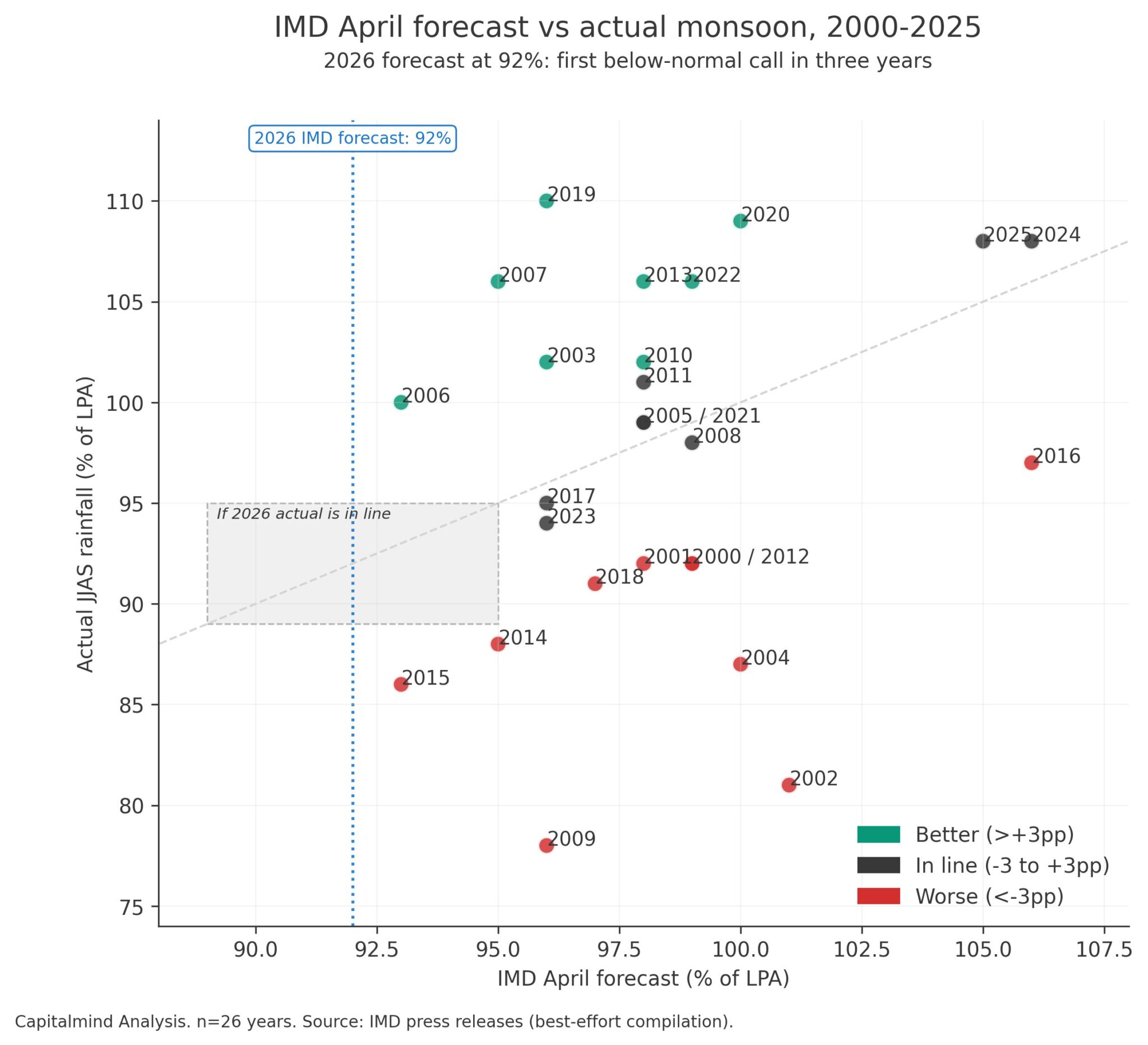
Because the April forecast carries so little rainfall information, any market reaction to it is a response to sentiment but not a reliable signal about the season ahead.
Weak monsoon forecasts do not predict an in-season selloff.
Years where the monsoon beat the April forecast once posted big June–September gains, ~ +14%, against +3% for the misses, an eleven-point gap. But split the sample and the gap falls apart: ~21 points in 2000–2012, essentially zero from 2013 on.
The chart groups each of the 26 years into three buckets; in-line (where June to September monsoon was within +/- 3% of April forecast), better (actual more than 3% over forecast) and worse (actual 3% or more worse than forecast). Then we look at mean Nifty 500 return in each bucket over three periods, the concurrent June to September period, subsequent Oct to December, and the following Jan to March.
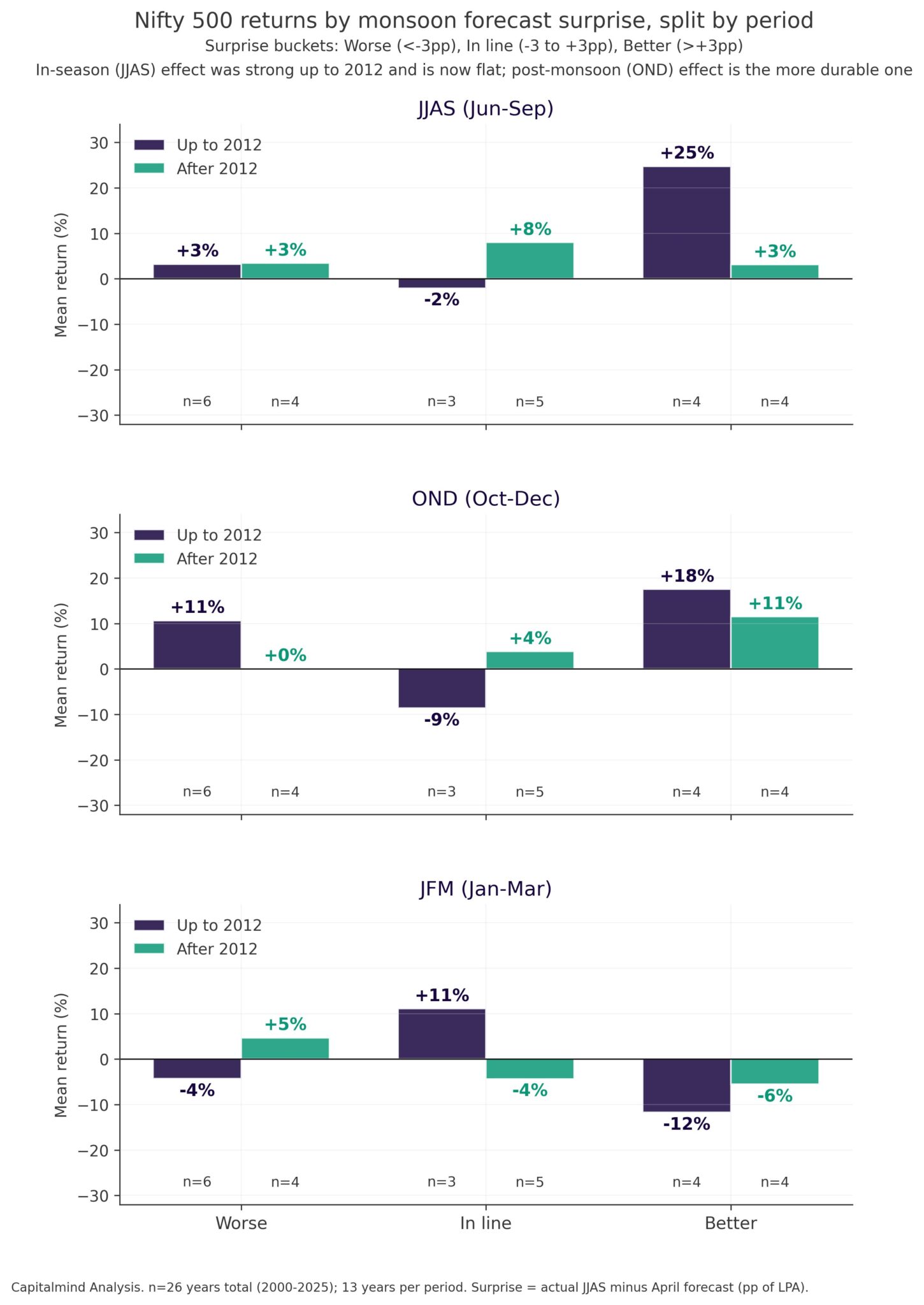
The market's in-season reaction to a monsoon surprise was strong before 2012 and has all but vanished in the decade since.
The One Outcome Weak Monsoon Forecasts (Sort Of) Predict
If anything, a weaker forecast has leaned the other way.
A worse-looking April forecast has gone with a stronger post-monsoon market, not a weaker one, the exact opposite of the naive prior.
Across 26 years, the lower IMD's April forecast, the stronger the subsequent October–December Nifty 500 return once the 2008 and 2020 shock years are removed.
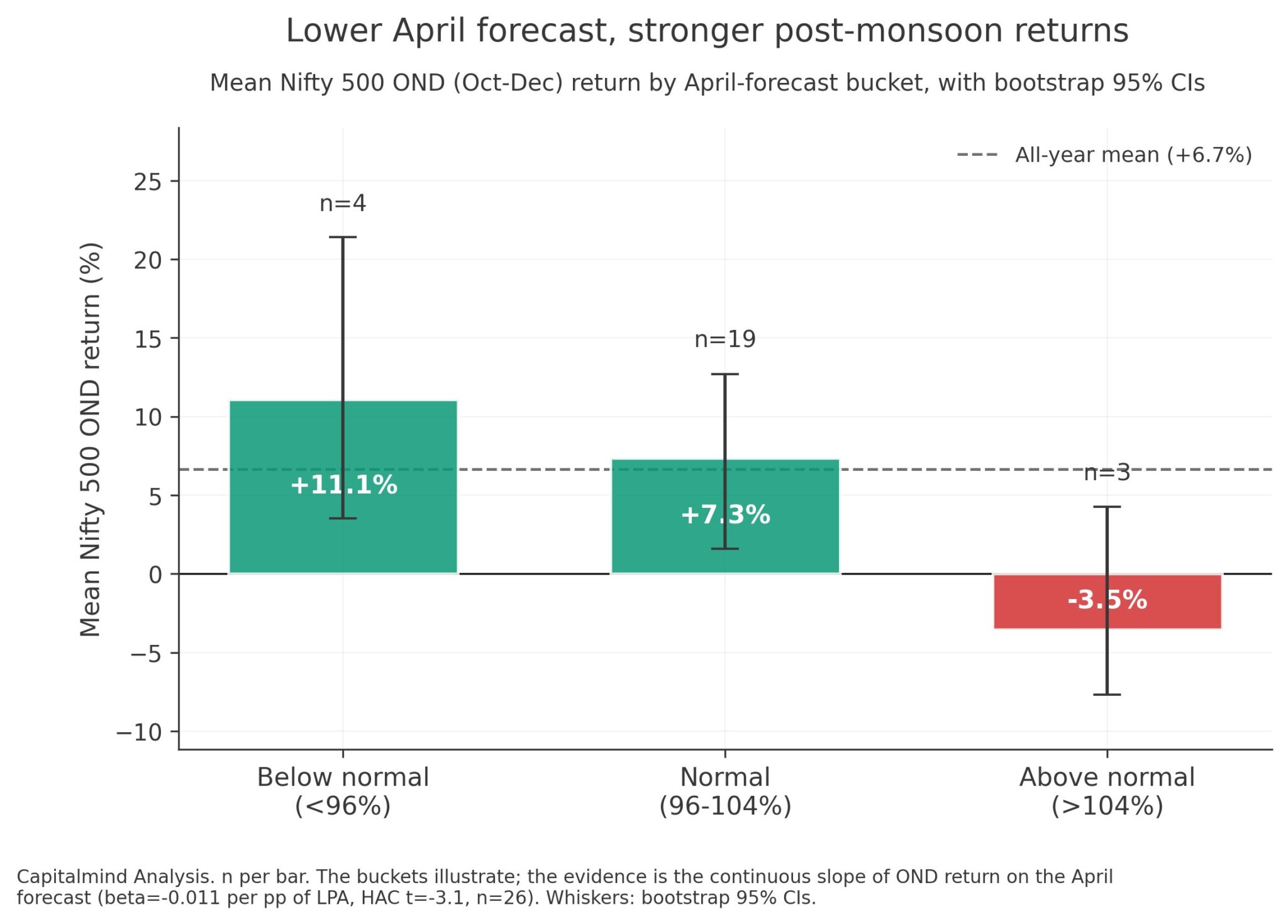
The buckets tell the same story and show how thin it is: the four below-normal-forecast years averaged +11% over October–December and each one was positive, including 2014 and 2015, when the actual monsoon came in deficient; the three above-normal-forecast years averaged about −3.5%. And the slope leans on a few extreme-forecast years at both ends: the three above-normal forecasts sit at 105–106%, far from where the rest cluster (93–101%), so dropping a handful of them softens it. Even the two worst droughts in the sample, 2002 (81% of LPA) and 2009 (78%), still posted +13% and +5% post-monsoon. The post-monsoon market did not fall apart even when the monsoon did. The likeliest reading is "wall of worry": a cautious forecast arrives into already-cautious expectations, and the relief when catastrophe fails to materialize shows up as a FY Q3 rally.
What the Data Cannot Say
We are relying on less than 30 annual observations, so not exactly the centuries of data that would signal robust conclusions. We also looked at various return windows and picked the three that made sense, but they could also produce significant-looking results purely by chance. Hence, when we removed a couple of the extreme years, the in-season surprise gaps do not survive that correction. Only the October–December-versus-April-forecast slope holds up, and that too if looked at charitably. Treat the whole set as hypothesis-generating: suggestive, not conclusive.
2026, in That Light
IMD's 2026 call was 92% of LPA in April, further cut to ~90% by late May with a ~60% chance of a deficient season. This is the lowest first-stage forecast in the sample as evident in the scatterplot chart above. On the pattern above, a below-normal forecast has tended to coincide with a better post-monsoon market, not a worse one. But that lean is directional at most because below-normal forecasts are rare, only four years (2006, ’07, ’14, ’15). The in-season effect has been gone for over a decade, and a slide into the deficient band where the late-May update now points, has no clean analogue among those four years.
The more realistic take is that the monsoon is rarely the variable to watch alone. Earlier in 2026 the worry was a soft monsoon stacking on elevated crude and the US-Iran conflict; that conflict has since wound down, and crude has come off its highs. The monsoon on its own has rarely moved the post-monsoon market much in either direction. The scenario to watch is several stresses landing together, not a soft monsoon by itself.
As analysts we prefer clean conclusive “If-this-then-that” findings. Unfortunately, none of what we found is strong enough to anchor portfolio decisions around. What we did find, to the question we opened with: a below-normal monsoon forecast is not, on its own a reason for an equity investor to worry.
The one pattern that holds up best runs against intuition: it is fear of below-normal monsoon, already in the price, that has historically been paid back in the post-monsoon quarter.
The monsoon is one of India's most-watched economic numbers but not a reliable market signal. It moves rural lives far more than it moves the market.
Related Posts
 Fact, Fiction and Factor Investing
Anoop Vijaykumar
 How to think about Asset Allocation in India – Part 2
Anoop Vijaykumar
 Decoding the hefty 512 Cr SEBI fine on Franklin Templeton
Deepak Shenoy
 No more evergreening through AIFs, says RBI to NBFCs
Deepak Shenoy
Make your money work as hard as you do.
Talk to a Capitalmind Client AdvisorInvesting is not one size fits all
Learn more about our distinct investment strategies and how they fit into your portfolio.
Learn more about our portfoliosUnlock your wealth potential
Start your journey today