(category)Charts & Analysis
Oil Shocks and Indian Stocks: Observations from HistoryOil Shocks and Indian Stocks: Observations from History
Since the Iran strikes began, Brent went from $70, touched $119 intraday on March 9, and is hovering around $90 per barrel as of writing this. Even the oil price can't decide how scared to be. Read on to see how Indian stocks have reacted to oil spikes in the past.
Anoop Vijaykumar•
24 episodes, 30 years of Nifty data, one question: do oil spikes actually predict worse equity returns?
Since the Iran strikes began, Brent went from $70, touched $119 intraday on March 9, and is hovering around $90 per barrel as of writing this. Even the oil price can't decide how scared to be. Indian equities reacted by quickly dropping about 5%, adding to a correction that was already 15% from the September 2025 peak. India imports 85% of its crude, so the reflex is familiar: oil up, equities down, get out.
We checked that reflex against history. We flagged every instance since 1995 where Brent moved 20% or more in a rolling month. That gave us 24 spike episodes and 20 crash episodes. For each one, we tracked what the Nifty 500 did over the next week, month, quarter, half-year, and year.
The data (ok the "anec"data), doesn't say what we'd expect.
The Paths After a Spike
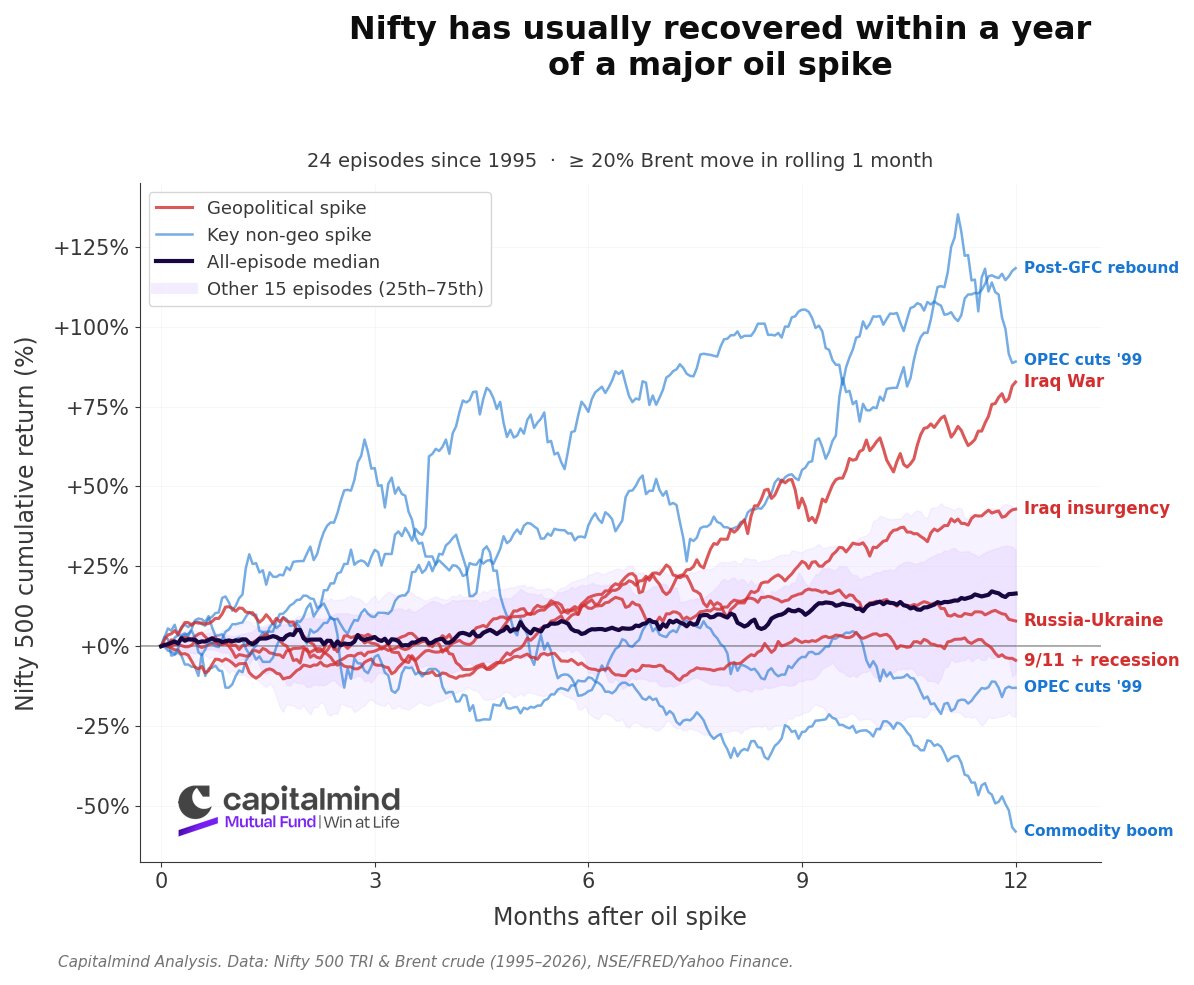
Twenty-four Nifty paths after oil spikes. The median line (dark) is solidly positive within months. The geopolitical episodes stand out: Iraq War (2002-03) recovery ran to +80%, Iraq insurgency (2004-05) to +43%, Russia-Ukraine (2022) recovered fully. The Commodity Boom of 2007-08 is the cautionary outlier, the one path where a spike preceded a sustained decline (and even there, the cause was a credit bubble, not the oil).
The Iran War '26 line is short and slightly negative. One week of data. Too early to read much into it.
Oil Direction Hasn't Predicted Equity Returns
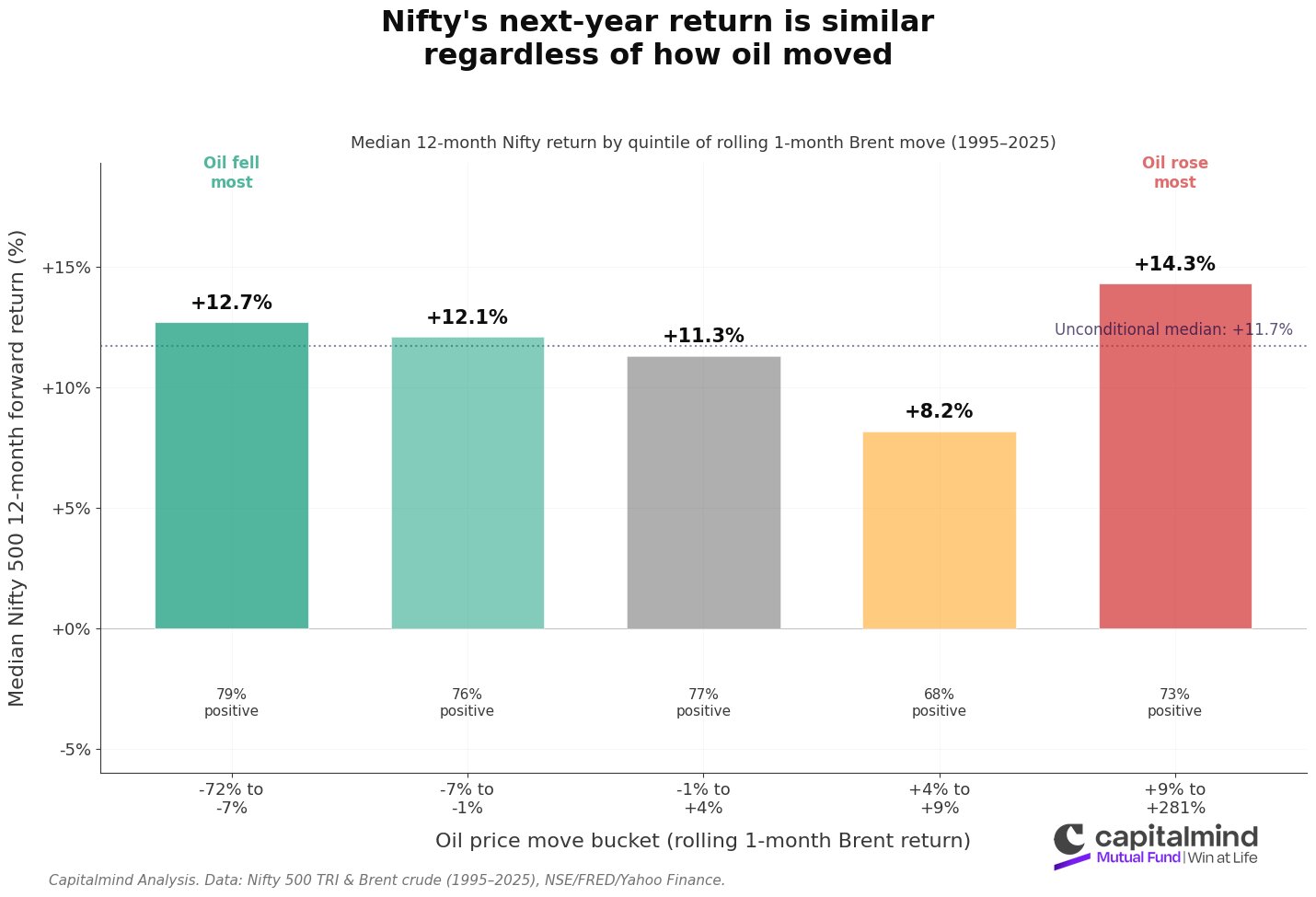
Forget the episodes for a moment. This chart uses every trading day in 30 years of data (over 7,000 observations). Bucket each day by how much oil moved over the prior month, and look at the Nifty's median return over the next 12 months. The left-most bar are the days when Oil fell the most, moving to the right are the days Oil rose the most. The bars are roughly the same height regardless of whether oil fell hard or rose hard. The range across all five quintiles: +8% to +14%: well within range of the long-term 12 month return of ~12%
A caveat on the 7,000 observations: consecutive trading days share most of the same data, so these aren't independent observations, so the effective sample is much smaller.
If oil direction were a useful signal for Indian equities, you'd see a clear slope in these bars. There isn't one. On most days, oil and Indian equities move in the same direction (counterintuitive!), dragged by shared global risk appetite. The daily correlation between Brent and the Nifty 500 across 30 years is actually positive (+0.09). The textbook cost-channel (higher oil squeezes margins) operates over quarters, too slowly to show up in how markets price risk day to day.
Post-Spike Years Look Like Normal Years, With Exceptions
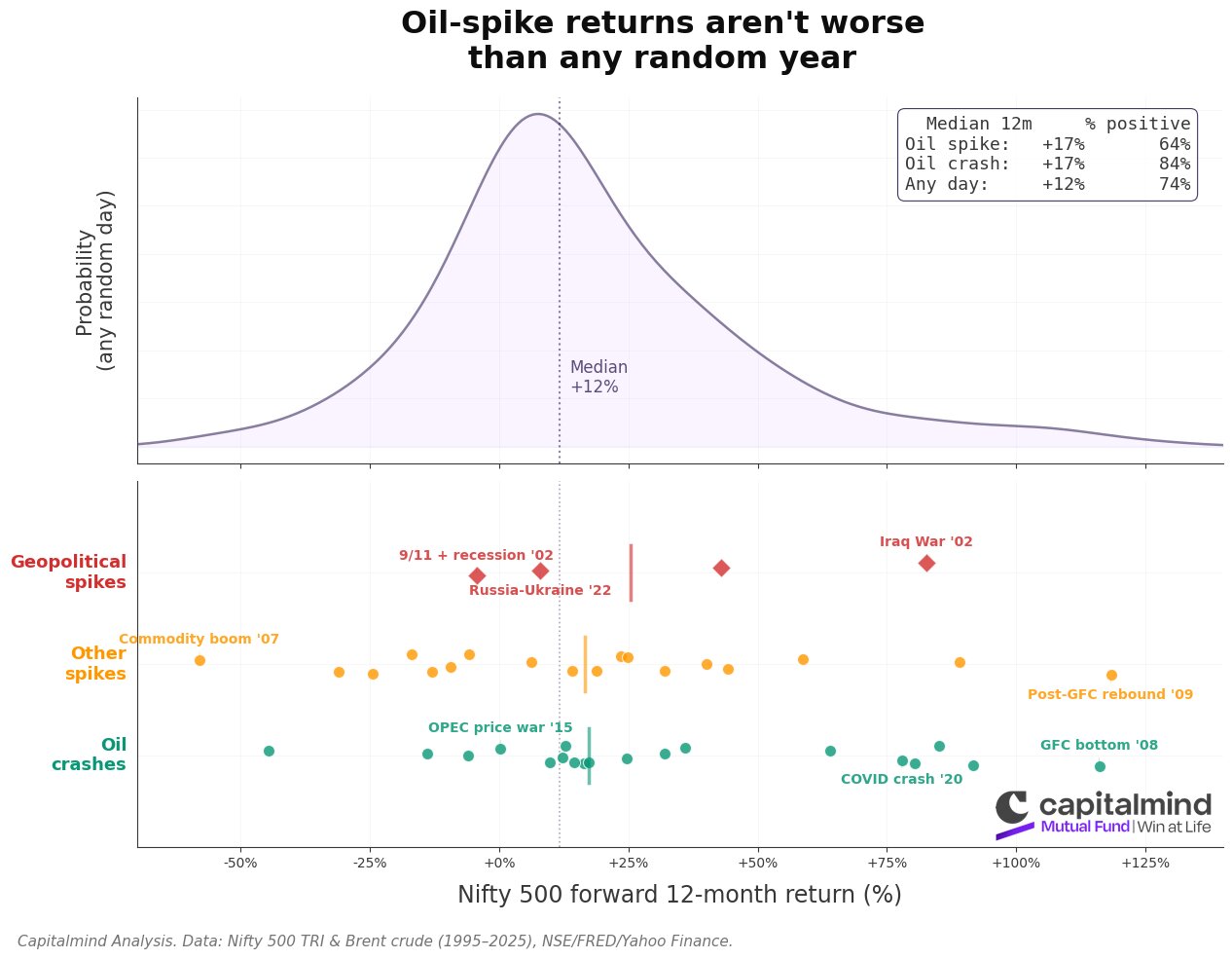
The bell curve shows the distribution of 12-month Nifty returns starting from any random day since 1995 (median: +11.7%, 74% positive). The dots below are returns after specific oil spike and crash episodes.
The geopolitical spike dots sit within the body of the distribution. They aren't clustered in the left tail. The feared outcome, where an oil spike leads to catastrophic equity returns, barely exists in the data.
The numbers: median 12-month return after oil spikes is +16.5%, versus +11.7% from any random starting day. 64% of post-spike years are positive (versus 74% unconditionally).
Post-spike years are slightly more volatile but not consistently worse. The median is actually higher, possibly because spikes tend to coincide with temporary fear that creates better entry points.
Short-Term Pain, Normal-To-Good Medium-Term Returns
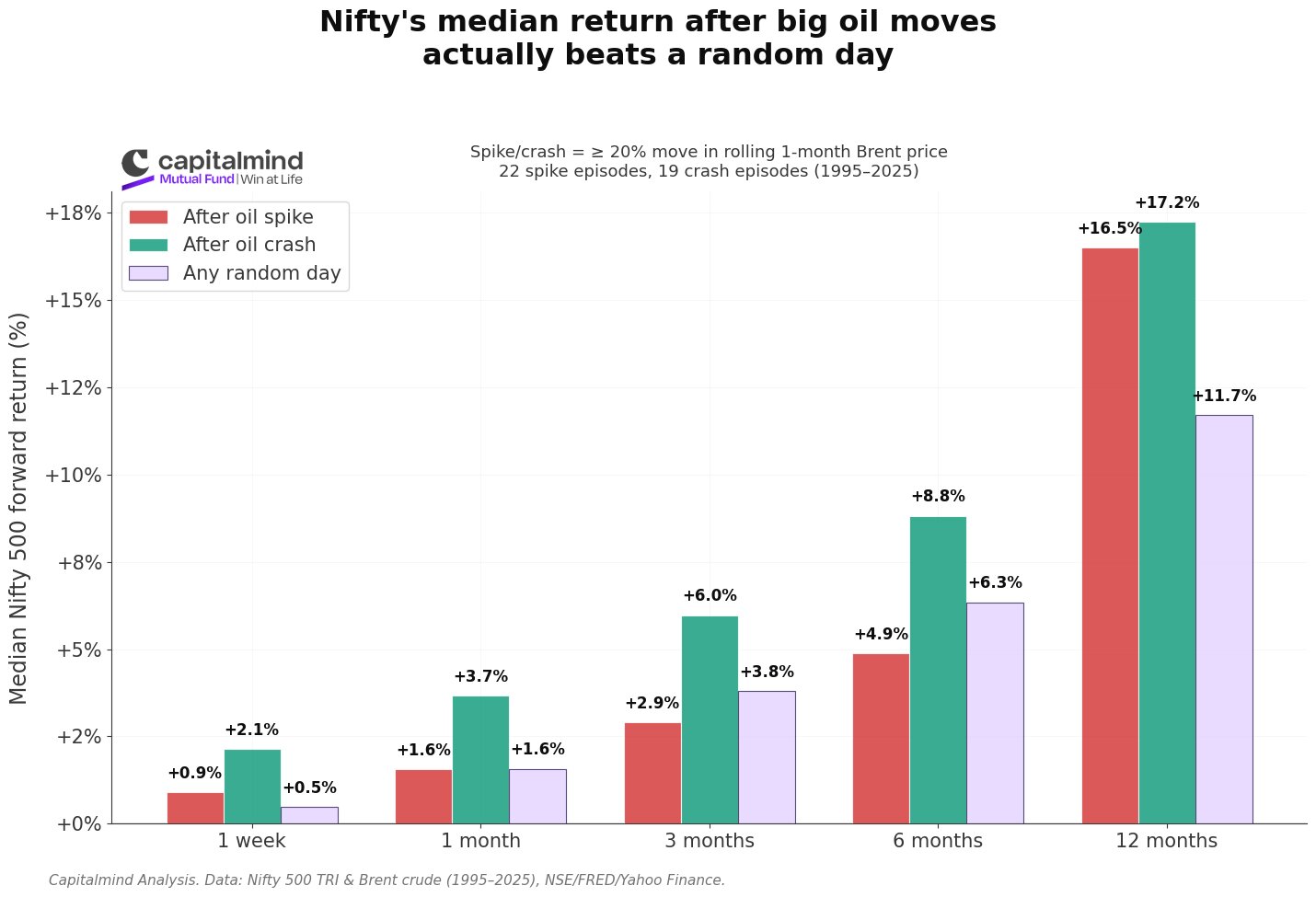
Post-spike median returns are positive at every horizon, from one week (+0.9%) to twelve months (+16.5%). At shorter horizons they roughly match a random day; by 6 and 12 months they pull ahead. Post-crash bars are higher at most horizons, a base-effect of measuring from panic lows like GFC and Covid, when almost any starting point produced strong recoveries.
How 10 Key Episodes Played Out
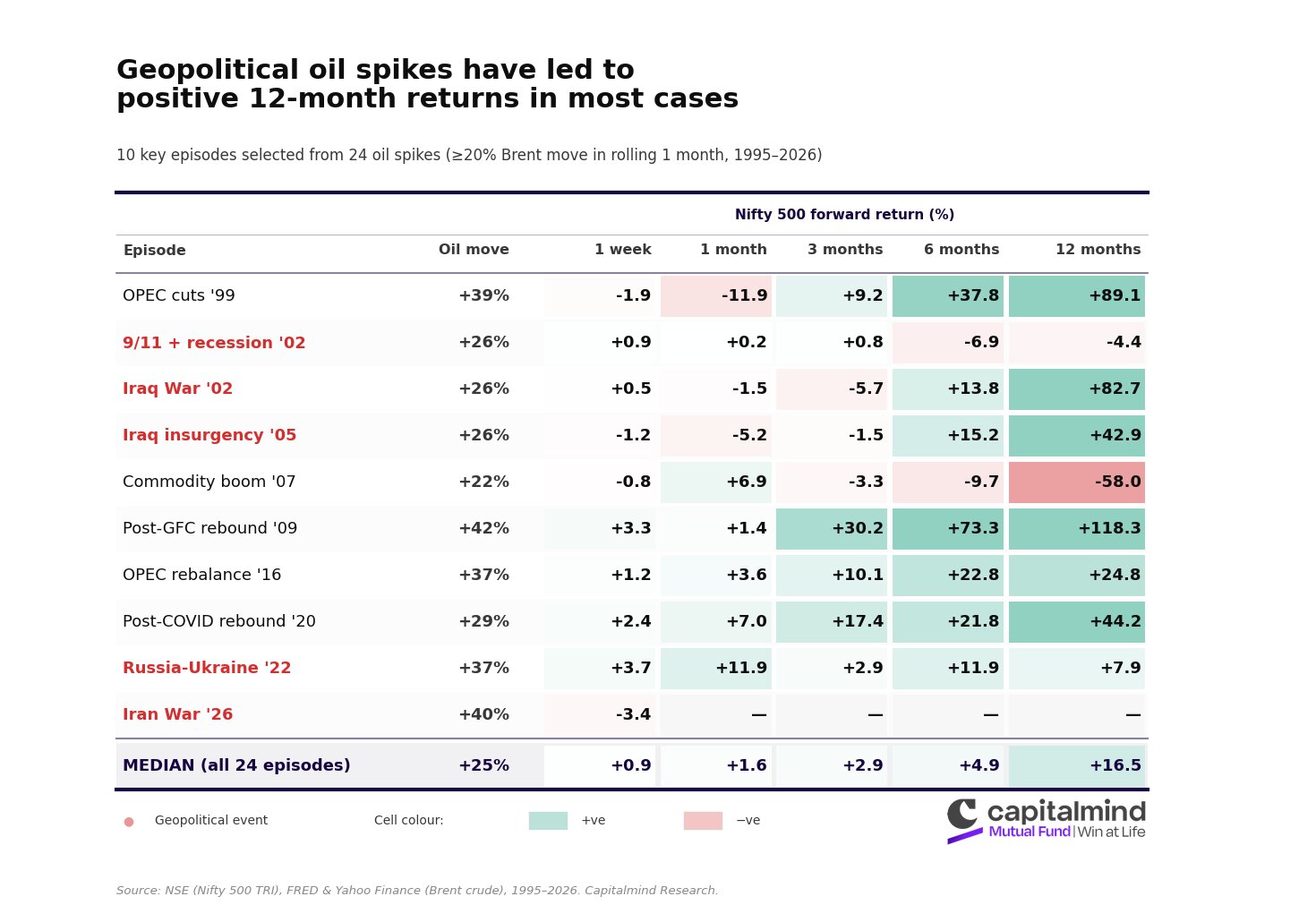
Ten episodes selected from the full 24 to cover the range of geopolitical, demand-driven, and supply-driven spikes. The geopolitical rows: Iraq War (2002-03) +82.7% at 12 months, Iraq insurgency (2004-05) +43.4%, Russia-Ukraine (2022) +11.9%. The lone negative among geopolitical spikes with a full year of data is the 9/11 period (-4.4%), and that coincided with a US recession already underway.
The median across all 24 spike episodes: +16.5% at 12 months.
Iran War '26 has one week of data so far. The 1-week return is -3.4%, consistent with the initial-shock pattern in prior episodes. Everything beyond that is unwritten.
What the Data Can and Cannot Tell You
To be clear: twenty-four episodes over thirty years is pattern-spotting at best. Each episode had its own context, its own macro backdrop, its own resolution. You can't run a regression on 24 observations and call it statistical rigour. But you can look at history and ask whether it supports the popular narrative. It doesn't seem to.
The Iran conflict adds a further caveat. It has no close precedent in this dataset: a military engagement with a major OPEC producer, within range of the Strait of Hormuz, which handles roughly a fifth of global seaborne oil. A contained geopolitical shock that resolves or gets absorbed within quarters has occurred multiple times. Prolonged disruption from a major producer has not occurred in this dataset, and the historical record offers no guide for it.
What we can say: in the majority of 24 episodes, the instinct to sell Indian equities because oil was spiking turned out to be wrong. The median post-spike investor who held for a year earned +16.5%.
Thirty years and twenty-four oil spikes suggest that the investors who got hurt were usually the ones who sold in a panic.
Related Posts
 Identities or Beliefs
Anoop Vijaykumar
 Execution as an Asset Class: Why Institutional Order Routing and Timed Rebalancing Matter
Akanksha Maulik
 The Returns You See Vs. The Returns You Keep
Anoop Vijaykumar
 Hidden Gems: Ten lesser-known Investing books You need to read
Anoop Vijaykumar
Make your money work as hard as you do.
Talk to a Capitalmind Client AdvisorInvesting is not one size fits all
Learn more about our distinct investment strategies and how they fit into your portfolio.
Learn more about our portfoliosUnlock your wealth potential
Start your journey today