(category)General
Does a Governance-Event-Driven Valuation Discount Ever Go Away?Does a Governance-Event-Driven Valuation Discount Ever Go Away?
When a company goes through a governance event, its stock usually falls. Sometimes the stock price doesn’t recover, while other times it does. But, here is a more important question: when the price does recover, does it come back all the way? Read on to know what this means and why it is important.
Sidhanth Paul•

In October 2018, Chanda Kochhar resigned as MD & CEO of ICICI Bank. She had been at the forefront for a decade. Her exit came amidst allegations of a questionable loan to Videocon Group, a subject that would eventually produce a CBI FIR, a Supreme Court case, and one of the most prominent bank-CEO related governance event.
Three years later, ICICI Bank was trading at 2.34 times the median P/E of Indian banks. Before the event, that number was 0.85. The stock, in other words, hadn't just recovered. It had been re-rated upward. The market wasn't extracting a trust tax from ICICI, it was paying a premium instead.
Now, let's consider another case: Brightcom Group. Three years after SEBI's April 2023 interim order banning the company from the securities markets, Brightcom's P/E relative to its sector had fallen by 46%. Similar three-year window. Opposite direction entirely.
If every governance news left a lasting discount on trust, we'd expect Brightcom's pattern to be the norm and ICICI's to be the exception. But the data begs to differ.
In our previous piece on corporate governance (which we strongly recommend you read first), we made the case on how governance events come in different shapes, and how each type of event affects the stock price differently. That piece answered whether prices recover, when does it recover, and when it doesn't.
This article tries to answer a slightly different question: Do stocks impacted by governance events ever recover in terms of valuations, or does the market attach a permanent trust tax?
What We Measured, and Why It Matters
Our previous analysis showed that roughly half the stocks in our sample recovered on price. But it ended with an unanswered question: Did the multiple suffer in spite of the price recovery?
Recovery on price versus recovery in terms of multiples are completely different. A bank stock which has gained 60% over three years after a governance issue, but underperformed the sector that gained 100% may have recovered on price, but not on multiple.
This valuation metric matters more than the absolute price recovery, and it's often far less explored. A stock can climb back to its old highs while quietly trading at a structurally lower P/E than it used to or versus its peers. Did the market really forgive? Or did it carry a permanent memory in the multiple even when the share price came back?
So we expanded the sample this time round and ran the numbers again. The first piece deliberately restricted itself to 22 events, but a study on recovery has survivorship bias baked into it. So we added more events to give the analysis a broader base to stand on.
We took each governance event from our expanded sample and did four measurements.
- First, the stock's median P/E in the three year timeframe before the event.
- Second, the stock's median P/E in a six-month window around the third anniversary of the event (3 months before the 3rd anniversary and 3 months post it).
- Then the same two measurements for P/B (price-to-book).
Then, and this is the important step, we divided each of those numbers by the sector median at the same point in time. That converts absolute multiples into relative ones. A pharma stock trading at a P/E of 30x when everyone else in pharma is at 30x is not the same as a pharma stock trading at 30x when everyone else is at 15x or 40x. The relative number strips out sector-wide re-ratings, so what's left is the market's judgment on that specific company.
The "discount" for each stock is how much its relative P/E fell between before and after the governance event. Zero means it re-rated exactly with its peers. Negative means it lost premium, or was trading at a comparative discount. Positive means it re-rated better than its peers did.
Even though we considered 44 events, our sample for this analysis got filtered down to 13 events, because the multiple-discount question can only be answered for stocks that:
- Actually recovered on price and
- Have at least three years of forward data.
Everything that went to zero or is too recent gets excluded by definition. Thirteen is small. Small enough that we can name every stock in the sample. Don’t consider it as statistics. It's thirteen individual case studies that fall into a pattern.
What were the Findings?
Before we dive into the findings, for folks who haven’t read the previous piece, here is quick recap on the kinds of governance events we wrote about:
- Confirmed fraud (Type A): The books are fake or the cash just isn't there.
Few examples would be Satyam in 2009, Manpasand in 2018, Vakrangee, also 2018. This news is binary and verifiable, once it's out, it's out, and the recovery, if any, is rare. - Promoter integrity (Type B): Related-party transactions, criminal conduct.
Yes Bank under Rana Kapoor, ICICI's Chanda Kochhar, the Singh brothers across Religare and Fortis are some of the examples. - Regulatory or legal probe (Type C): An investigation by SEBI, SFIO, the DOJ, the SEC.
Adani's US bribery allegations (2024-26) is an optimal example. Usually multi-year resolutions with wide outcome ranges. - Short-seller, activist, or whistleblower report (Type D): A third party makes detailed allegations; it is not necessary that the company gets charged. Mixed credibility could often lead to bimodal outcomes.
- Board or structural governance (Type E): An independent director resigns, the chairman exits, the auditor walks away.
Atanu Chakraborty's HDFC Bank resignation in March 2026 is an example of this. - Related party or disclosure lapse (Type F): A specific transaction wasn't disclosed correctly. Not always fraud, sometimes a technical lapse, sometimes the first thread of a larger problem.
PC Jeweller in 2018 or HDFC Bank's MSRDC deposit story in May 2026. Usually narrow.
Five stocks came out with a real, meaningful discount to their pre-event relative multiple, while eight came out at the same or higher (few of them substantially higher). The following table is sorted by T+3Y P/E discount, most discounted first.
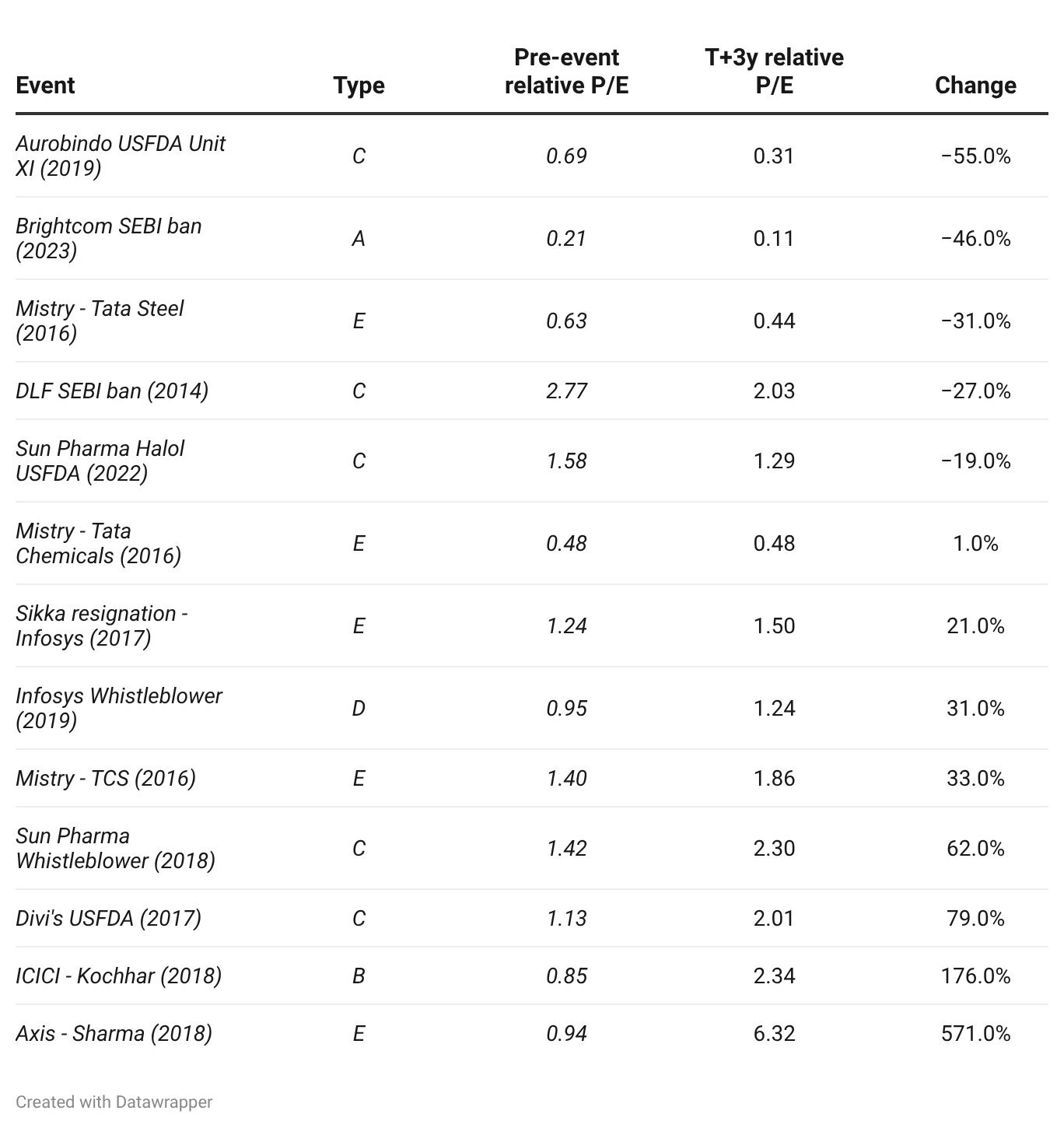
Note: A note on how the P/E numbers are computed. Every P/E in this analysis uses the previous financial year's reported EPS, with an 85-day lag from year-end before newly-filed earnings enter the calculation. This ensures that on any given date, the P/E reflects earnings that were genuinely public and digested, no look-ahead bias, and every stock in the comparison is on the same reporting cycle. Apples to apples.
(Axis Bank's number will make you do a double-take. We did too, the number holds up. Axis's median P/E in early 2021 was ~118 versus a sector median of ~19, but it needs context, and we'll come to it. The short version: Axis's own earnings were still suppressed by pandemic-era credit-cost provisions in FY20, which made its P/E look artificially high. The genuine re-rating story for Axis is more modest than the P/E number alone suggests.)
That table is clearly split into two groups. Now it is really about what distinguishes the two.
What Separates the Two Groups
One: Was the event contained to a person or moment, or did it point to a business problem?
The stocks which trade at a premium after an event are almost all in the first category. Sikka's resignation wasn't a comment on Infosys's software services business, same with Kochhar and ICICI's actual banking franchise. Shikha Sharma's fourth-term denial was an RBI intervention on tenure, not on Axis's asset quality. The Mistry ouster hit five listed Tata companies simultaneously, but nothing about their day-to-day businesses changed.
The discount stocks are different. Aurobindo's Unit XI wasn't its only headache, but a surface expression of a wider compliance pattern. Sun Pharma's 2022 Halol warning came seven years after the first at the same facility. Brightcom's SEBI action landed on top of years of visible audit concerns. DLF's 2014 ban coincided with a six-year property downturn.
Two: Was the underlying business a strong franchise?
Every one of the premium stocks is a franchise that has outperformed anyway, for reasons unrelated to governance. ICICI, Axis, Infosys, TCS, Sun Pharma, Divi's, these are compounders. Governance issues were more of temporary hurdles in their multi-year climbs.
The discount stocks can’t be considered to be the same. Brightcom was more ad-tech aspiration than execution. Aurobindo is large but not category-defining. DLF only ever rises and falls with the property cycle. The multiples for them didn't come back because there wasn't much for the market to regain confidence in.
Three: Did the sector re-rate around them, or without them?
This is easy to miss. Pharma consolidated at higher multiples between 2019 and 2024. Financials re-rated spectacularly post-COVID. Software services expanded through the pandemic. A stock that had a governance event in 2018 could see its relative multiple rise substantially just because its sector did, even without the market specifically forgiving governance. Sector tides lift most boats.
The discount stocks missed the tide. Real estate underperformed for years after 2014, Aurobindo's USFDA-troubled sub-segment underperformed pharma, etc.
Two Anomalies Worth Naming
Sun Pharma appears twice, but with different outcomes. The 2018 complaint turned into a +62% P/E re-rating, while the 2022 Halol USFDA warning, translated into a -19% discount.
The difference is that the 2018 event was a one-off allegation that got investigated and settled without material findings. The 2022 Halol warning was the second USFDA warning at the same facility in seven years. Repeated, at the same location, was the market's cue that this wasn't containable. It was maybe structural.
Then there's the Axis Bank problem. The 571% P/E re-rating is technically correct, but it comes with a footnote. Axis's P/E at T+3Y (early 2021) was 118x, but it wasn't a market judgment, it was arithmetic. Axis's FY20 earnings were suppressed by pandemic-era credit-cost provisions. The denominator of the P/E ratio was temporarily small, so the ratio looked temporarily huge.
The way to see through this is to look at Axis's relative P/B, which moved only +4% over the same three years, versus ICICI's +96%. When both P/E and P/B move together, the re-rating could be understood as durable and real. When only P/E moves and P/B is flat, the "re-rating" might just be the market pricing a temporary earnings depression as a temporary thing.
The P/E versus P/B Questions?
This was not a section, which I thought I would be writing about when starting the article. However, the Axis Bank case has opened up a broader point worth the discussion.
Across the 13 observations, P/E and P/B have usually moved together, but not always, and where they diverge, the P/B number is usually the more honest one.
ICICI Bank: P/E +176%, P/B +96%. Both large, both durable. Re-rated intrinsically? Sure.
Sun Pharma 2018 whistleblower: P/E +62%, P/B -23%. The re-rating was mostly about earnings normalisation post-Ranbaxy integration, less about a permanent trust premium.
Sikka Infosys: P/E +21%, P/B +33%. Interestingly, P/B moved more than P/E, suggesting the market's view of Infosys's underlying franchise strengthened more than the earnings pace showed.
TCS Mistry: P/E +33%, P/B -9%. The re-rating was earnings-driven, not book-value driven, consistent with TCS being priced for cash generation rather than asset accumulation.
This is worth internalising as an investor. When you read that a stock "re-rated after a governance event", ask whether the business actually got stronger, or whether the ratios just did.
What to Do When the Next One Lands
The market has a shorter memory than most investors assume. Eight of our thirteen traded at the same or a higher relative multiple three years on. A permanent trust tax showed up in only 5 of them.
The severity of the event is also not what separated them. Aurobindo’s was a compliance finding. Brightcom’s was an outright SEBI market ban. Both ended up discounted. So did DLF, whose real problem in 2014 was arguably a six year property downturn.
None of this argues for selling on the headline. The market's first reaction to governance news is noise.The practical takeaway would be that governance events are slow-resolving, and the instinct to act fast is usually wrong.
What you're actually waiting to see is whether the business keeps performing after the event, because that, not the market's memory, is what decides where the multiple eventually settles. Earnings that hold and execution that continues will drag the multiple back up. A business that quietly weakens will keep it down, and no amount of time could fix that.
And when the multiple does climb back, looking at one particular metric in silo doesn’t help. A re-rating that shows up fundamentally i.e., on earnings as well as sentiment is the market genuinely changing its mind.
The Caveats
Everything which we have talked about till now is descriptive, not statistical. Think of it as a set of case studies from which a pattern emerges.
The sample also has real limits worth flagging. Stocks that never recovered on price aren't in this analysis by construction; e.g. DHFL, Coffee Day, the outright frauds, because they didn't have a "multiple three years later" to measure. That's survivorship bias baked in, which we talked about in the initial bits of this read. Our sample is biased toward companies that survived, and among survivors, the market's forgiveness is really only visible for companies that had a strong enough business to survive with in the first place.
We think the pattern is real and we're not going to pretend the sample is definitive.
Where That Leaves Us
We went looking for a trust tax and mostly found a business-quality tax wearing its clothes.
The ICICI-Kochhar story,ultimately, wasn't really about the market attaching a trust tax. It was more about the market realising that ICICI Bank was a better franchise than it had been priced as before the event took place. That's re-evaluation.
Meanwhile, Brightcom moved the other way. Three years on from the SEBI ban, the stock sat at 11% of its sector's median P/E, not because the market remembered the governance event, but because the business hadn't given it a reason to re-evaluate upward. The governance event set the initial price. The business kept it there.
Only one of them really came back on valuations. And the difference between them wasn't governance memory, it was what each business proved about itself in the years that followed.
Related Posts
 Happy Diwali 2025! More Useless Predictions Even Though...
Deepak Shenoy
 PMS Inner Workings: Banking Partners, Custody Structure, and Trading Execution
Akanksha Maulik
 The futility of analyst recommendations
Anoop Vijaykumar
 PMS Guide for NRIs: The Nuts and Bolts
Akanksha Maulik
Make your money work as hard as you do.
Talk to a Capitalmind Client AdvisorInvesting is not one size fits all
Learn more about our distinct investment strategies and how they fit into your portfolio.
Learn more about our portfoliosUnlock your wealth potential
Start your journey today