(category)General
You Don’t Live Through AveragesYou Don’t Live Through Averages
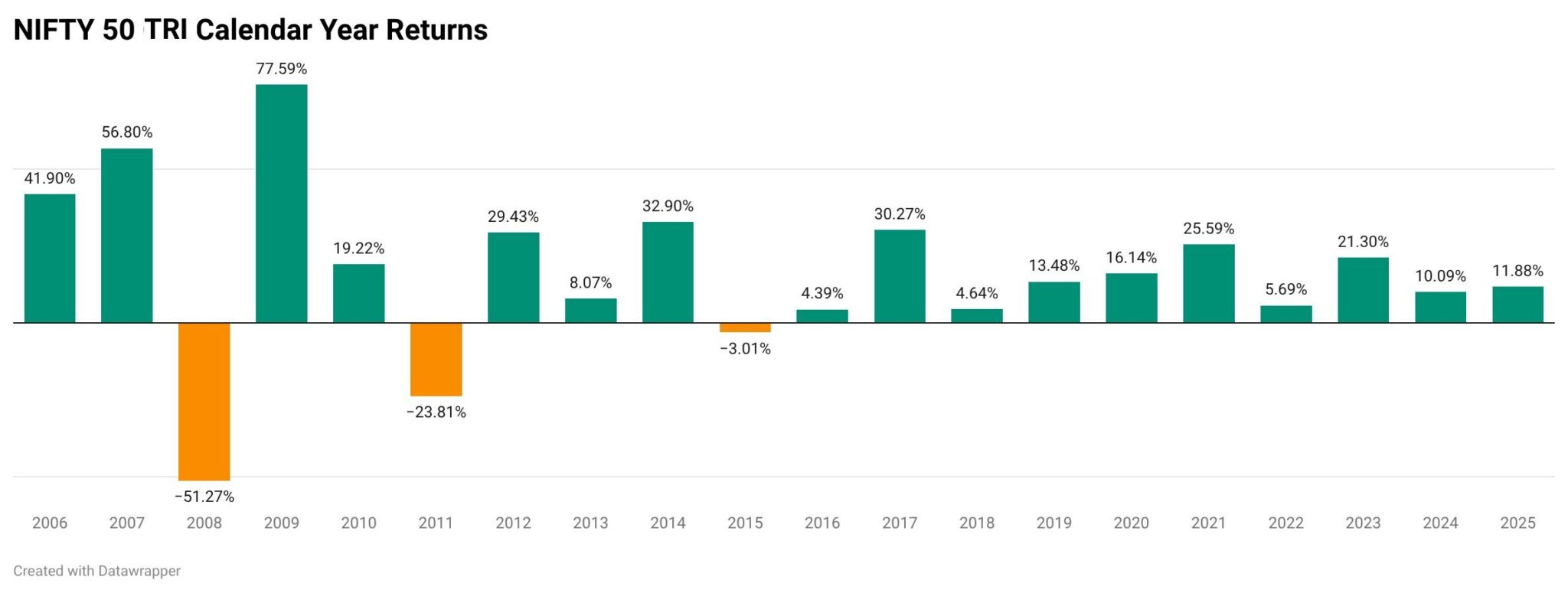
The Nifty 50 TRI has compounded at ~11.5% since 2006. Only 4 of the last 20 years delivered a return inside that generous 8 to 16% band. Read on to know why that's so and what it has to do with Kohli's batting average.
Aaryan Sanghavi•

You're watching Virat Kohli walk out to bat. You haven't admitted it to yourself, but you've already done the mental math. His ODI average is 58.71, so somewhere in the back of your head you've settled on a number that would feel about right “a fifty, maybe pushing into the seventies and definitely above forty.” That's not the innings you usually get. Across 299 ODI innings, 234 of his scores have landed outside even a generous band of 40 to 80 runs. More than three out of every four times you've watched him bat, the number on the screen has been well below that band or well above it. You've either been gutted that he was dismissed cheaply, or on your feet because he was building something special. The quiet, just-okay innings closest to his average is the one you almost never get to watch.
On a per match basis, you would either be ecstatic or despondent. However, if you watch him play enough times, you’ll be content with the risk you took each time you bought a ticket. The fan who shows up for a golden duck and decides never to return saves himself the next bad day, but he also misses everything that comes after. The fan who shows up for one of his 54 centuries and walks away at the top convinces himself nothing will live up to that, and is wrong for the same reason. Both quit on a single match. But across nearly two decades of watching one of the all-time greats, the bargain works out for every long-time Kohli fan: content with the risk, even after the days they walked out of the stadium gutted.
Equity markets work exactly the same way, and it costs you a lot more than it costs the cricket fan.
For years you’ve had “12% annual returns on equities” thrown at you. You latch onto the promised 12% number as the expectation to justify the risk of putting your money into equities. You probably account for uncertainty the same way the Kohli fan does, with a mental hedge “surely if the average return is 12%, I can expect something between 10 to 14, or, more generously, somewhere between 8 and 16.” Well…no.
The Nifty 50 TRI has compounded at ~11.5% since 2006. Look at each calendar year in isolation, and only 4 of the last 20 years delivered a return inside that generous 8 to 16% band.
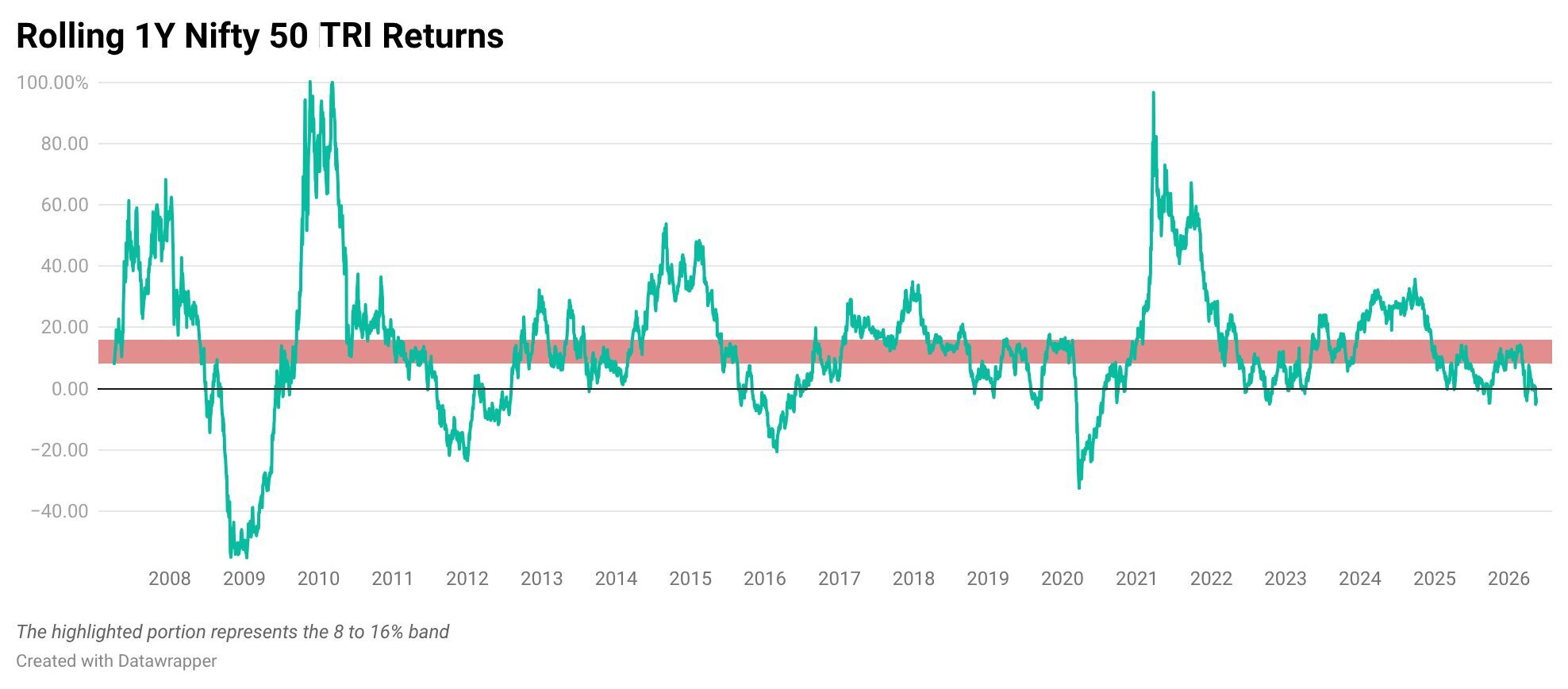
Even if you look at it the way you actually experience the market, every possible day on which you could have bought and held for a year, 4978 rolling one-year windows (yes, we counted), the picture barely improves. The return landed inside the 8% to 16% band just 23.5% of the time; the same one-in-four ratio as Kohli's career. More than three out of every four times, you would have ended up either ecstatic or despondent. The tighter 10% to 14% band (the one closest to what you actually picture when you hear "12%") caught barely one in eight years.
If I were to take the cricket analogy further, in a year well below your 8% floor, you conclude the equity story was oversold. In a year well above your 16% ceiling, you decide to take your winnings off the table before the market corrects. Either way, you move to fixed deposits. Either way, you tell yourself you're being smart.
You quit on a single year, before the long-run number has a chance to do what long-run numbers do. Same mistake. Different costume.
The same is true for longer holding periods that still fall short of how long the average takes to reveal itself. If you land in the upper tail, you'll be pleasantly surprised. You wouldn't mind the extra money, but you didn't plan around it either. If you land in the lower tail, you'll be disappointed for the opposite reason. Either way, you're sampling from a window too short to count on. Stay long enough, and the surprises in either direction begin to converge into the number you were promised.
So here’s what it looks like the longer you hold your positions. The below table depicts the probability of you being in the “expected annual market returns” range for NIFTY 50 TRI since 2006.
| Rolling Period | Annualized Return Range | Times within the 10 to 14% band | Times within the 8 to 16% band |
| 1 Year | -55.3% to 100.3% | 12.87% | 23.53% |
| 2 Years | -18.2% to 56.1% | 14.67% | 31.75% |
| 3 Years | -4.5% to 32.4% | 27.67% | 52.98% |
| 5 Years | -1.0% to 26.9% | 36.41% | 62.95% |
| 10 Years | 5.1% to 17.2% | 53.47% | 92.58% |
At five years, the bands tighten, and it's only when you stretch your horizon to ten years that the picture stabilizes. Over 90% of ten-year windows landed within the generous ±4% band around the long-run CAGR.
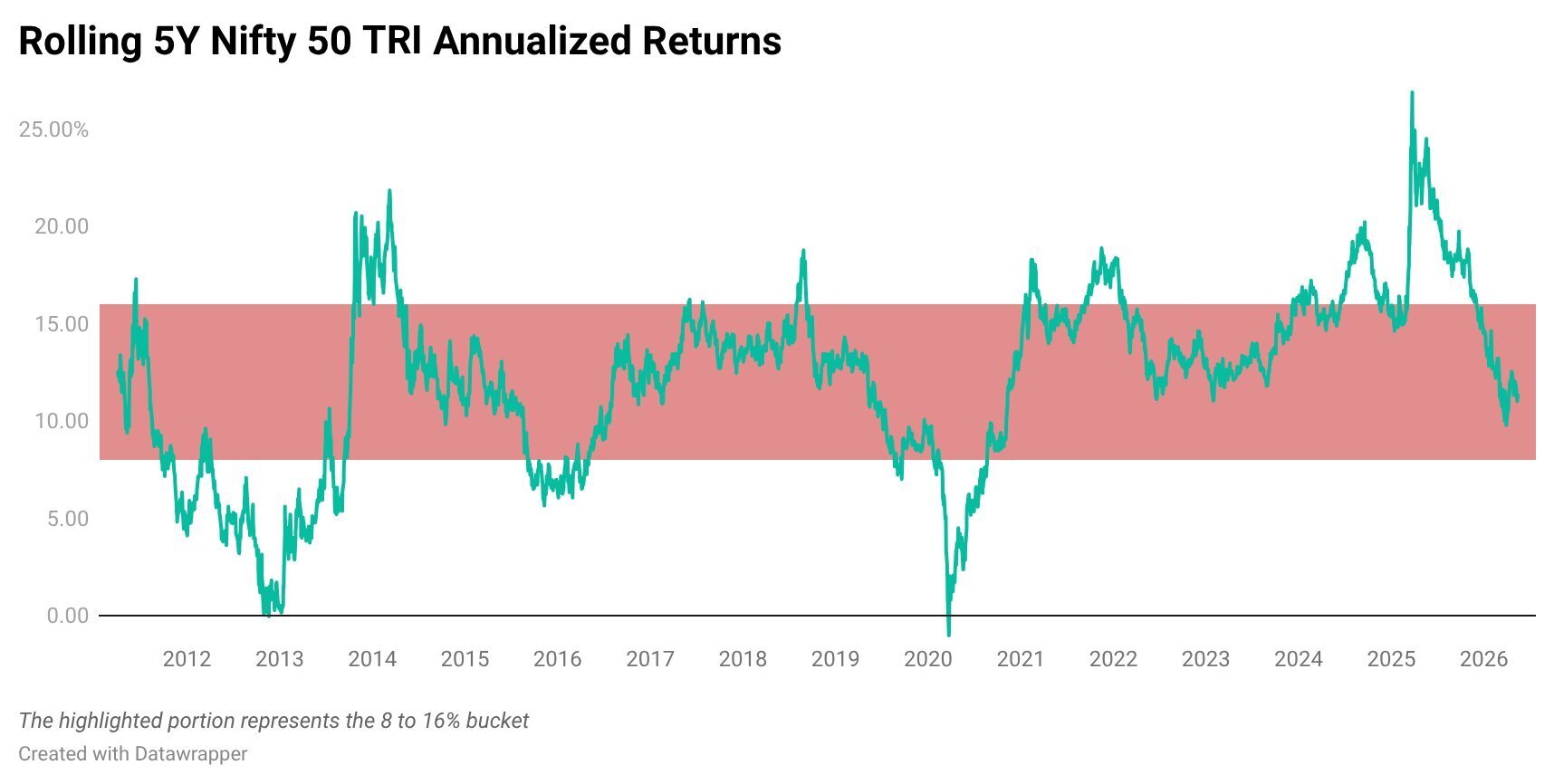
So, all of this to say you should expect the long-run average over … the long run. Not over a year, not over three, but over a horizon long enough for the extremes to cancel each other out. The five-year window is the first one at which you can reasonably expect to have lived through the ups and downs of equity markets and still walked away with a return that justifies the risk you took. As the data suggests, you'd have landed inside the generous 8 to 16% band nearly two in three times. Stretch the horizon to a full decade and that number climbs to over nine in ten, by which point you can be almost certain of meeting your expectation of the average. Anything shorter than five years, and you're not investing in the long-run promise. You're sampling from a distribution that may or may not be kind to you.
The promise of ~12% is historically real, but it isn’t a promise about your next year, or even your next three. It's a promise about a body of time long enough for the average to actually show up. The average year isn’t something you should expect to live through every year. The average 5-year period or an average decade, in all likelihood, gives the outcome of the average year over the horizon. Equities make sense only if that's the horizon you're planning around, and the return you're prepared to accept. Anything else is a gamble dressed as a plan.
Related Posts
 Are You Holding an Underperforming Mutual Fund?
Sahil Jain
 Eight Billion Simulations, One Pit Stop
Divyansh Agnani
 It's been 10 years at Capitalmind!
Deepak Shenoy
 How a Zero Cost EMI Actually Costs 9%
Deepak Shenoy
Make your money work as hard as you do.
Talk to a Capitalmind Client AdvisorInvesting is not one size fits all
Learn more about our distinct investment strategies and how they fit into your portfolio.
Learn more about our portfoliosUnlock your wealth potential
Start your journey today