(category)General
The world is paying more to borrow. India is paying for it, too.The world is paying more to borrow. India is paying for it, too.
Bond markets are repricing trust everywhere. And India is being repriced, too, from a growth stock to value stock. This is not necessarily a bad thing. Read on to know why.
Krishna Appala•

Why rising global yields and a compressing “India premium” are the same story
Bond yields globally are at levels we haven't seen in a generation. In India, consumers aren't spending, and foreign investors aren't buying. These look like different stories. They are not. The market, globally and locally, is repricing trust.
The global bond market is talking. Loudly.
Long-dated yields across the developed world have climbed in a way they haven't for a generation. The US 30-year Treasury crossed 5% earlier this year, up 4X from 2020 levels of around 1.2%. UK gilts at the long end remain near multi-decade highs.
But the most jarring move is in Japan. The 30-year JGB has crossed 4% while the 10-year is above 2.7%. For context, Japan's 10-year traded around zero for the better part of a decade. We are watching, in real time, a regime change that economists assured us couldn't happen here.
So, what does it mean when lenders demand more to lend? From where we stand, it means trust is walking out of the room.
Bond buyers (pension funds, insurers, sovereign wealth, and central banks) are pricing in two risks.
- The first is inflation. If prices don't stay tame, the real return on whatever they buy today gets eaten alive.
- The second is supply. Governments aren't slowing down their borrowing, and someone has to absorb the flood of fresh issuance.
Higher yields are how the market demands compensation for both scenarios.
The implications of higher borrowing costs have started to ricochet across the world. The clearest signal is in the US. Interest payments on American federal debt now run over $1 trillion annually. To put that in context, that's roughly what the US spends on defense. Every basis point higher on the 10-year adds tens of billions to the bill. The math is starting to look uncomfortable for the White House.
This is what bond vigilantes look like. They don't show up with placards. They show up asking for high yields.
Meanwhile, in India, buyers are also stepping back
The headline GDP number for India is still ticking along respectably. But scratch a layer below and the picture changes.
Volume recovery in mass-consumption categories has been anything but V-shaped. The auto sector is a good indicator. India's two-wheeler industry took 7 years to reclaim its FY19 sales peak, and it needed a GST cut from 28% to 18% to finally cross the line in FY26. Entry-level car sales have lost their post-Covid bounce. Premium consumption holds up; mass-market consumption doesn't. You can see this trend repeated across sectors. The widening split between the well-off and everyone else isn't conjecture anymore. It's what the data reflects, quarter after quarter.
Sentiments across consumer sentiment surveys continue to remain weak. The RBI's own consumer confidence index has been below 100 (the line that separates optimism from pessimism) for an uncomfortably long stretch. The situation remains the same across urban and rural areas as well.
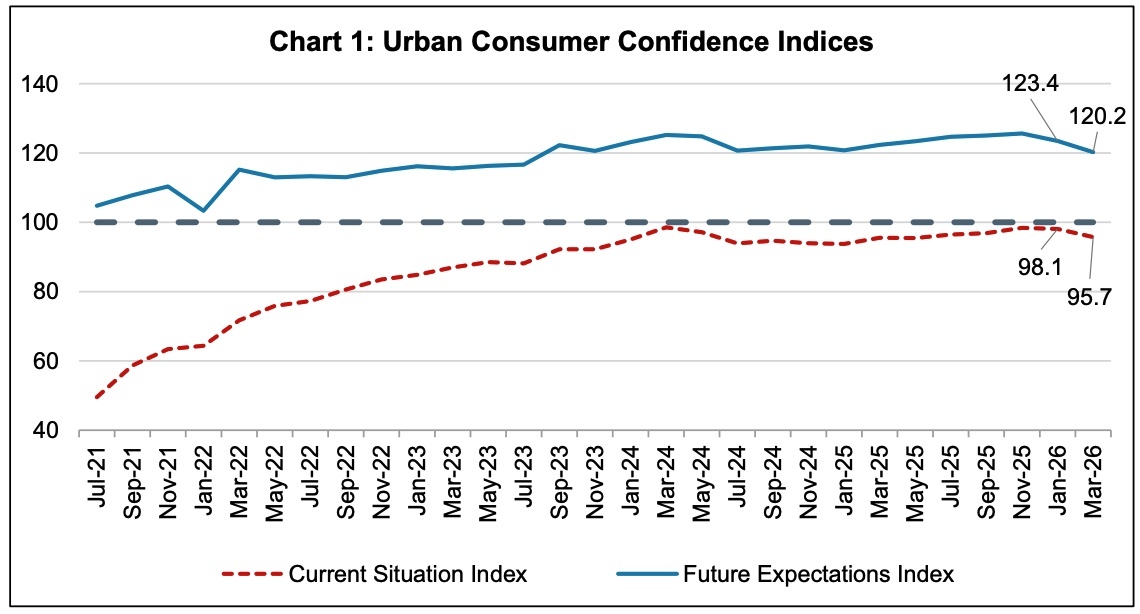
Source: RBI Urban Consumer Confidence Survey
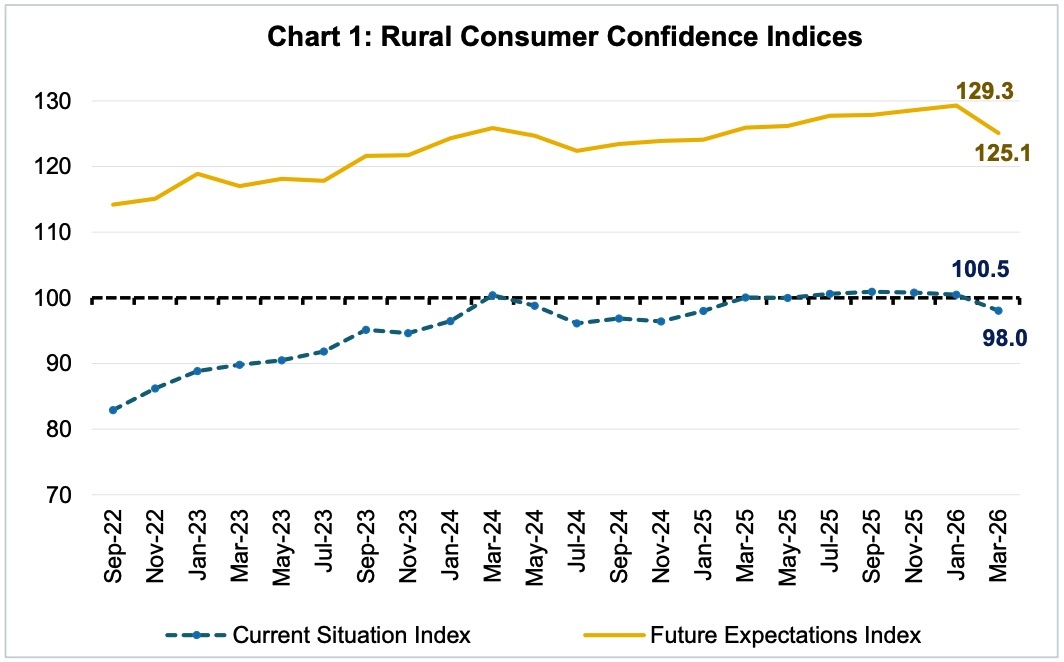
Source: RBI Rural Consumer Confidence Survey
Not to mention, the data above doesn't fully capture the impact of the ongoing war and the rise in crude oil prices, which will take the next couple of months to have an effect.
India is now a value stock
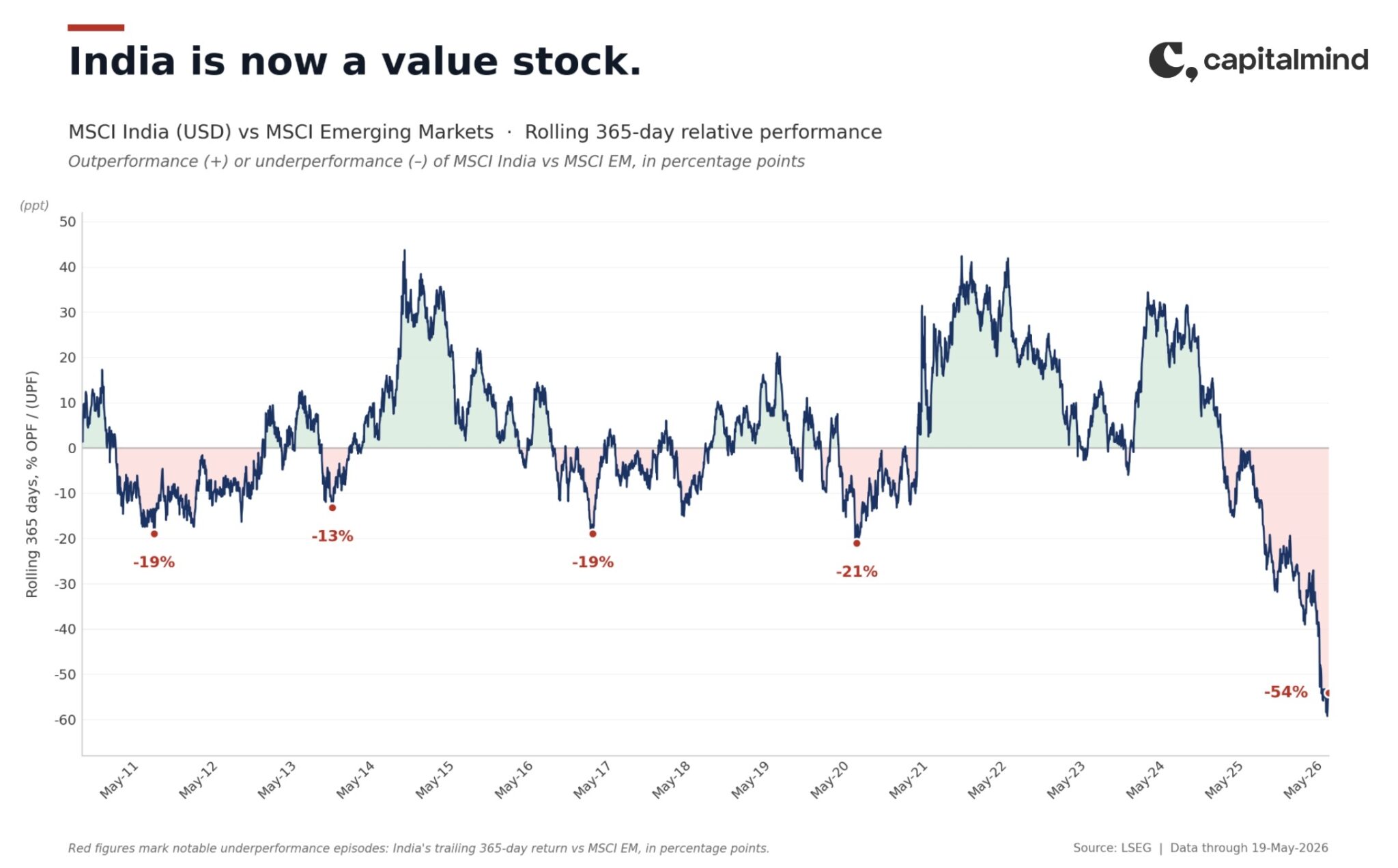
Meanwhile, something has been shifting slowly but steadily in the Indian markets. FIIs have been net sellers for several quarters, with substantial cumulative outflows. Domestic flows have held the market up, but the relative narrative is changing. You can see this in the chart below. For fifteen years, MSCI India's (USD) underperformance against MSCI Emerging Markets (USD) was shallow and short-lived. Every dip was followed by a recovery. "Buy India when it lags EM" was a near-mechanical trade.
That pattern has broken. The latest reading sits at -54% points, more than twice as deep as anything before, and it has been deepening, not bouncing. This isn't a dip waiting to be bought. This is an asset that has been reclassified.
India is almost going from being priced as a growth stock to being priced as a value stock.
This isn't necessarily bad. Value stocks, too, compound. They just compound on different terms. The expectations are lower, the multiples are saner, and the room for upside surprise is wider. A market that's stopped paying for hope is a market where good news actually moves prices.
But it does mean a few things have to change in how investors here think.
Capitalmind Wealth’s view
First, the easy decade is over. Buy-anything-and-hold worked from 2014 to early 2024 because the macro was tailwind-heavy: falling rates globally, FII inflows, and a domestic consumption story that explained itself. Few of those conditions hold cleanly today.
Second, asset allocation matters again. When global yields are at these levels and Indian G-Sec is in the 6.5-7% range, fixed income and non-equity asset classes earn their place in a portfolio. Not the way it did during the zero-rate years (which were an anomaly, not a feature), but the way it traditionally did before central banks broke the bond market in 2020. However, fixed income comes with its taxation issues in India; but hybrid mutual funds can offer a tax efficient way to get fixed income and other asset class diversification. That’s why we launched our “Anchor” investment approach in the PMS which is a basket of hybrid mutual funds where the target overall portfolio allocation is split 50/50 among equity and non-equity asset classes.
Third, equity returns from here will lean on earnings, not multiples. We think that the multiple expansion phase may be largely done. Companies that can grow earnings through a sentiment slowdown will get rewarded. Those that can't, will get re-rated downward, and possibly quickly. In our Surge India stock portfolio of the PMS, we have a massive focus on earnings and earnings growth.
Fourth, and this is the boring one. Stay invested but stay diversified. The global story (US debt math, Japan's regime change at the long end) is not going to resolve in a quarter or two. The Indian story (consumer sentiment, white-collar slowdown) might turn faster but probably won't turn on its own. RBI has room to cut, the government has room to spend, and the festive season usually does some work. The macro situation will improve sometime. The question is whether you have the patience to be there when it does.
The same number, in three different units
In bonds, it shows up as yield. In consumption, as the EMI burden divided by job security. In equities, as the P/E multiple. Three asset classes, one question underneath all of them: how sure are you about the future?
The honest answer, right now, quite possibly is “less sure than we were”. That's fine. Markets work in cycles, and trust is the most cyclical thing in them. The decade that just ended ran on tailwinds. The next phase will run on discipline.
That suits us. Process beats prophecy, especially in markets where prophecy is now expensive.
Related Posts




Make your money work as hard as you do.
Talk to a Capitalmind Client AdvisorInvesting is not one size fits all
Learn more about our distinct investment strategies and how they fit into your portfolio.
Learn more about our portfoliosUnlock your wealth potential
Start your journey today