(category)General
When Equity Becomes Cash: The Math Behind Your ESOP WindfallWhen Equity Becomes Cash: The Math Behind Your ESOP Windfall
The first action with any windfall is to write down three numbers on a single page. Every other decision in the next twelve months (diversification, asset allocation, should I buy a house) is downstream of getting this number right. If you are expecting or in line for ESOP liquidity, read on to know what those numbers are and what they mean for your wealth.
Akanksha Maulik•

There’s a moment in every windfall conversation when the math doesn’t math.
You’re sitting across from someone who’s just had a decade of equity convert into a tradeable number. Their phone has been buzzing all morning. Their CA has emailed twice. A cousin’s banker friend has called, and a college batchmate who knows the markets has sent three forwards on WhatsApp. And somewhere in the middle of all this (usually about twenty minutes into the meeting) they pull up their broker screen, point at the holdings tab, and ask the question:
But this is real money, right?
Yes, partially.
Your Holdings Tab Lies a Little
Let’s start with a worked example. The numbers are illustrative. Your strike, your exercise date, and your slab will be different, but the math doesn’t change.
Let’s say you were granted 1,00,000 ESOPs at a strike of INR 10 per share. You exercised them on listing day, when the fair market value (FMV) was INR 221. Today, the stock trades at around INR 190. Your demat screen shows INR 1.9 crore.
Here’s what actually happened, and what the screen leaves out.
On exercise day, the Income Tax Department treated the gap between FMV and your strike as perquisite income, taxable as salary at your slab rate. The formula is straightforward:
Perquisite value = (FMV at exercise − exercise price) × number of shares
= (INR 221 − INR 10) × 1,00,000
= INR 2.1 crore
That INR 2.1 crore was added to your salary for the year. At a 39% effective slab (which is roughly where you land with surcharge once you cross INR 2 crore total income), the tax bill on this single line item was about INR 82 lakh.
This tax needs to be paid in cash as tax for the financial year before you sold a single share. Either your employer ran a sell-to-cover (sold a chunk of your shares at exercise to fund the TDS) or you wrote a personal cheque. Either way, INR 82 lakh of value has already left the building.
(Note: Employees of startups certified as “eligible startups” under Section 80-IAC can defer this tax until the earliest of (a) 48 months from the end of the assessment year of allotment, (b) sale of the shares, or (c) cessation of employment. However, employees of other companies, including listed-company ESOP holders cannot do so. Therefore, we’ll keep the example simple.)
At 10 per share × 1,00,000 shares, exercising the options cost you 10 lakh upfront. This also has to be paid to the company to actually convert your vested options into shares.
So the cheque hits your account for INR 1.9 crore. The tax you’ve already paid is INR 82 lakh, and the act of exercising your options costs of INR 10 lakh. This cost of INR 92 lakh isn’t an abstraction. It was real money that came out of either your shareholding or your savings. The Holdings tab doesn’t show it, but your tax advisor’s calculations will.
Net new wealth from this whole episode: INR 1.9 crore − INR 82 lakh - INR 10 lakh ≈ INR 98 lakh.
Now fast-forward to today. The share is now listed and trading at INR 190. You sell your shares at INR 190. What happens?
For capital gains purposes, your cost basis is the FMV at exercise, not the strike. This is deliberate. The law has already taxed the strike-to-FMV gap once as salary. To tax it again as capital gain would be double taxation, and the Income-tax Act explicitly avoids this under Section 49(2AA).
Capital gain = Sale price − FMV at exercise
= (INR 190 − INR 221) × 1,00,000
= INR 31 lakh loss (short-term, since less than 12 months from exercise)
The capital gains line on your ITR shows a loss, which you can set off against other short-term gains (which is a small consolation).
[Note for clarity : A capital loss isn't tax owed. It's a number that reduces your tax elsewhere when set off against other short-term gains. No further tax leaves your account from this sale. The only real cash out from this whole episode is the ₹82 lakh perquisite tax from last year and INR 10 lakh exercise cost.]
Now consider the uglier version. If you exercised when the stock was at INR 242 (say, on a post-listing high) rather than at IPO, the perquisite tax would be higher at ~INR 90 lakh. With exercising cost at INR 10 lakh, that would have meant an outflow of INR 1 crore. Today’s value would still be INR 1.9 crore, and your net wealth from the episode would stand at ~INR 90 lakh. You’ve paid tax on a value higher than what you’re holding. You have a notional short-term loss to set off against, but the economics are clear: the windfall is smaller than the screen says, and meaningfully smaller if you exercised at a price above today’s.
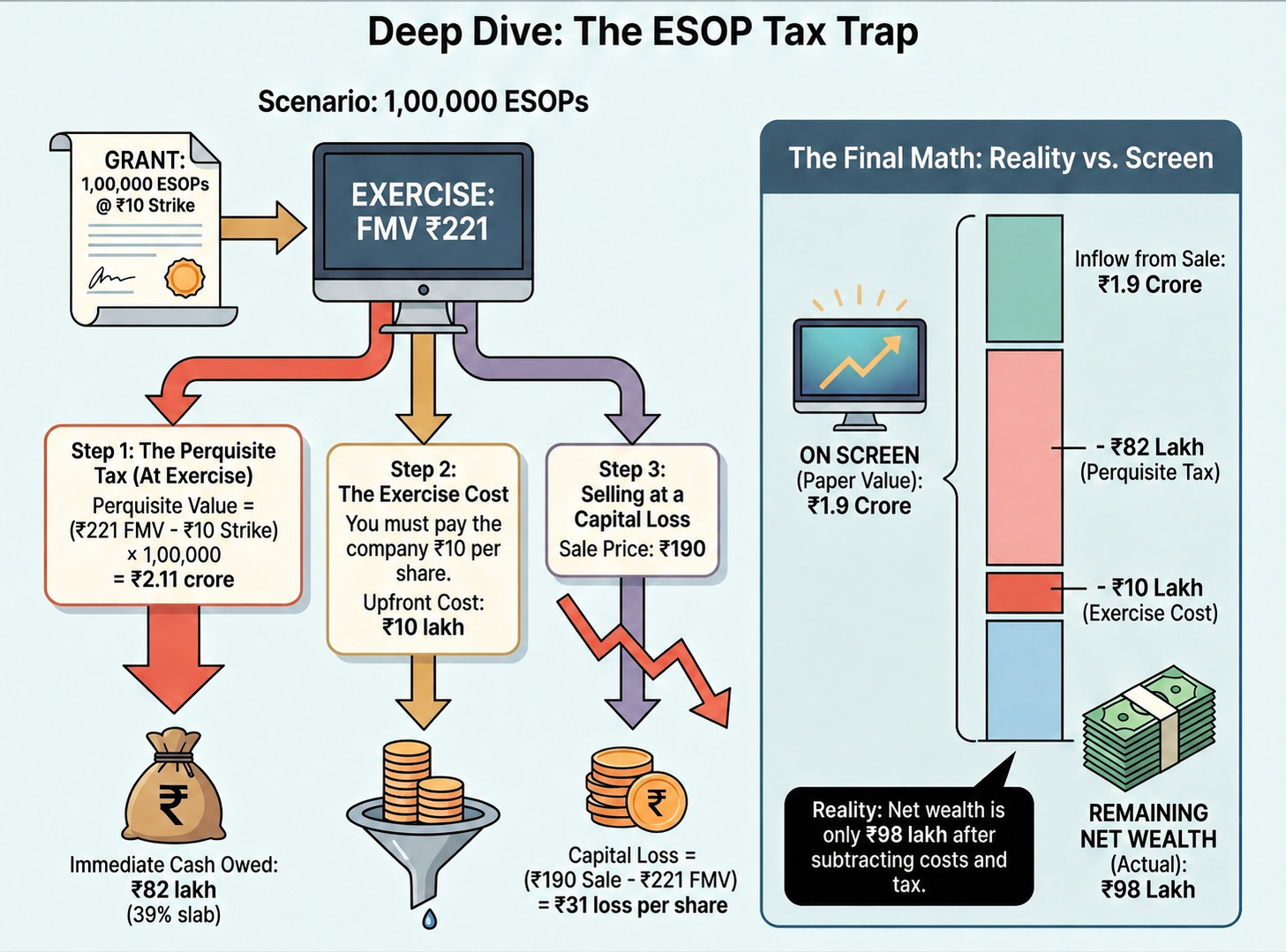
This is what we mean by the tax trap at exercise. The perquisite is what is called a phantom income event. You owe tax on a paper gain, in cash, often before any liquidity is available. By the time the lock-in lifts and you can actually sell, the world has moved on. And almost nobody we meet has done this math before the cheque clears.
The first action with any windfall is to write down three numbers on a single page:
- Tax already paid (or owed) on the perquisite
- Capital gains tax payable if you sell at today’s price (in the above example that was zero as the sale generated a capital loss)
- Net cash after both
That third number is your real starting position. Every other decision in the next twelve months (diversification, asset allocation, should I buy a house) is downstream of getting this number right.
The Five Things to Do Before You Do Anything
Most advisors will start with portfolio allocation. You should start two steps earlier, because that’s where the real damage gets done.
Step 1 Clear the basics. Settle the perquisite tax bill if it isn’t already settled. Pay off any expensive personal debt (anything above 10% post-tax—credit card balances, personal loans, sometimes car loans). Park 12 months of household expenses in a liquid fund or arbitrage fund. Then re-check your insurance. Your employer cover almost certainly doesn’t fit your new net worth, and term insurance gets meaningfully more expensive after age 40. Get this done in week one. It buys you the most valuable thing in a windfall, time to think without pressure.
Step 2 Segment your goals. A common mistake is to treat the windfall as one portfolio. It isn’t. Retirement at 55, your child’s education in 2032, a house renovation next year, a corpus you want to leave behind, those are four different problems with four different time horizons and four different risk tolerances. Bucket them. The overall portfolio is the sum of the buckets, not a single allocation. (In Marathi they say thamba—hold your horses.) The bucketing exercise feels slow. It saves you a decade of churn.
Step 3 Allocate assets. This is where most advisors start. By the time you get here, you should already know your time horizons and your liquidity needs, which means you’re choosing across asset classes rather than reacting. Diversification beats market timing. Chasing alpha always comes with risk. Markets are volatile by nature, and your investment doesn’t care about your feelings. (We’re not saying anything original here. We’re saying it because, somewhere in month two, you’ll be tempted to forget it.)
Step 4 Keep it transparent. A low, transparent fee structure beats a complex one with hidden costs (such as performance fees) almost every time. No lock-ins, no exit loads, no profit share, and every position visible to you in real time. Invest in stocks or mutual funds depending on what fits your tax situation and your preference—both are legitimate vehicles. A PMS structure puts all of it in one demat account in your name. That matters for transparency, and it matters for what happens to your family if something happens to you.
Step 5 Stay invested. This is the unglamorous one. Most of the return in a long-term portfolio comes from time in the market, not timing of the market (again, not original). Periodic reviews, proactive communication during volatility, and a relationship manager to help manage behaviour—these aren’t features. They’re the entire game.
Most advisors start at Step 3. We spend the most time on Steps 1 and 2, because in our nine years of managing wealth for UHNIs, that’s where windfall mistakes actually happen.
Two Windfalls, Two Paths
A bit of context for what this looks like in practice. Names and round-tripping the numbers a bit, but the cases are real.
Client A: The founder with INR 800 crore.
After selling a stake in his business, this client had INR 800 crore parked in mostly debt - about 90% debt, 10% equity. His instinct was capital protection: he’d just had a single liquidity event, and the idea of putting most of it into equity was uncomfortable.
We didn’t argue with his instinct. We worked with it. Over five years, we phased the allocation from 90:10 (Debt:Equity) toward 50:50, aligning the equity additions with market drawdowns and his own household cash flows. The equity went into our long-term equity strategies, with discipline on rebalancing rather than discretion on stock picks. The debt was consolidated into high-quality short and long-duration paper, with liquidity carved out for known outflows. For disclosure, the client worked with multiple advisors and we acted as super-advisor to the overall portfolio.
Five years on, the portfolio has compounded steadily, the family has had clean reviews against generational goals, and the 50:50 allocation now functions as the long-term wealth engine the founder wanted in the first place. The interesting bit isn’t the allocation. It’s that the journey took five years and felt deliberate the whole way.
Client B: The IPO recipient.
An IPO event delivered life-changing wealth to this client. Existing assets were already 75% equity-biased, which is a different starting position from Client A. The brief here was to ring-fence enough cash for three years of household expenses and travel, and compound the rest aggressively.
We mapped every rupee to a goal first. The short-term buffer (about 15% of the corpus) went into low-risk debt-like instruments, ring-fenced and fully de-risked from equity market volatility. The remaining 85% went into a mix mostly tilted to long-term equity strategies, with about 90% of the strategic equity dedicated to long-term and legacy goals.
Final allocation: 65% equity, 35% debt. Cushion in place for three years. Core engine running for compounding. Both ends of the timeline were covered. All of this done with Mutual Funds and stocks alone. No structured product.
Neither of these is exotic or clever stock pick. Both come down to doing Steps 1 and 2 carefully before touching Step 3.
Our View
A windfall is not a money problem. It’s a sequencing problem.
Most windfalls don’t fail because of bad allocation. They fail because the first thirty days went wrong. Tax got handled reactively. Concentration got rationalised as conviction. Advisors got hired in a hurry. A safe 10% bond got bought because somebody promised it. By the time someone sits down to actually allocate, half the bad decisions are already in place and the next two years are about unwinding them.
The fix requires patience that the first month of a windfall actively works against. Settle the basics. Segment by goal. Allocate by horizon. Keep it transparent. Stay invested.
Disclaimer: This post is for general information and discussion purposes only and does not constitute investment, tax, or legal advice. Examples used are illustrative; actual tax outcomes depend on individual circumstances, slab rates, holding periods, and applicable provisions of the Income-tax Act. Capitalmind Financial Services Pvt Ltd is a SEBI-registered Portfolio Manager (Registration No. INP000005847). Investments are subject to market risks; please read all related documents carefully and consult your own tax and legal advisors before making any decisions.
Related Posts
 PMS Inner Workings: Banking Partners, Custody Structure, and Trading Execution
Akanksha Maulik
 The Wartime Economy and Rough Times
Deepak Shenoy
 PMS as MF Wrapper: Testing the RIA Alternative
Akanksha Maulik
 Brief guide to ESOP taxation in India
CM Team
Make your money work as hard as you do.
Talk to a Capitalmind Client AdvisorInvesting is not one size fits all
Learn more about our distinct investment strategies and how they fit into your portfolio.
Learn more about our portfoliosUnlock your wealth potential
Start your journey today