(category)CM Strategy
Surge India: Five Themes for the Next 5 YearsSurge India: Five Themes for the Next 5 Years
Surge India, our oldest investment approach, turns nine. How has India's growth story shaped our stock portfolio, and which five investment themes are guiding us now? Read on to know.
Krishna Appala•

Our Oldest PMS Investment Approach Turns 9
When we got our PMS license in late 2017, we needed to create a portfolio as our first product offering. We launched a stock basket where the core thesis was to invest in companies that stand to gain most from India’s growth story. The simple idea was to choose key macro themes, then take a fundamental approach to selecting 3 to 5 stocks in each theme, and give each stock-pick 3 to 4 quarters to prove itself. That was the birth of Surge India, which just turned 9 and is currently our biggest investment approach.
9 years of running real client money on a fundamental basis, investing in emerging themes, has taught us plenty about what we got right, what we didn’t, and what course correction really means. These learnings shaped how the strategy works today. We are as confident about Surge India’s investment thesis today as we were 9 years ago. India is the fastest-growing large economy in the world, and barring a series of black swan events, that is not expected to change.
But First, Let’s Take a Step Back
Two years ago, every global investor wanted to invest in India. They called it the TINA (There Is No Alternative) trade. Now the sentiment has moved on to “Anywhere but India”. Having said that, matters, and perspectives, are constantly evolving. The question is, will it sustain?
Swedish physician and statistician Hans Rosling co-authored a book called Factfulness where he attempts to explain this impulse to downplay the upsides. The book says that on most things that matter, the world is doing better than we think, and smart people get it wrong most of the time. The author calls it the “Negativity Instinct”. It looks like Indian markets have been viewed in a similar way by foreign institutional investors for the last 12 months.
To understand better, let’s have a quick quiz. Pick an answer before you read the next line. No googling, please.
1. Over the last 10 years, India’s dependence on imported oil has:
- Gone down
- Stayed the same
- Gone up
Answer: Gone up. We now import about 88% of the crude we use, up from around 84% a decade ago.
2. Ten years back, India imported most of its mobile phones. Today India:
- Still imports most
- Makes about half
- Makes almost all, and exports too
Answer: Makes almost all, 99%, and went from near-zero to over 2.6 lakh Cr of exports as of Mar 2026.
3. India has 1.4 billion people, and most are not rich. So who’s spending more right now:
- The mass market
- The premium and luxury buyers
- Equal split between mass and premium buyers
Answer: The premium and luxury buyers
4. Indian households hold approx. 30,000 tons of gold. Compared with the official gold reserves of the world’s top 10 central banks put together, that is:
- Much less
- About the same
- Much more
Answer: Much more. Indian families hold more gold in their homes and lockers than the US, Germany, Italy, France, Russia, and China hold in their central bank vaults, combined. It is worth roughly $4-5 trillion, close to 90% of our GDP.
5. Which is bigger: Indians who put money into mutual funds through SIPs every month, or Indians who actually pay income tax?
- Taxpayers, by a mile
- Roughly equal
- The SIP investors
Answer: Answer: The SIP investors. Around 5 to 6 Cr Indians invest in mutual funds (across 10 Cr SIP accounts), against roughly 3 crore who actually pay income tax. Nearly 9 crore file returns, but two out of three pay zero tax.
How many did you get right?
You see, India has real problems, and we need to be honest about them. But things are improving, and that is where the opportunity lies.
The Five Themes of Surge India
Here are the five themes we are betting on for the next five years. Surge India is built on these themes.
1) Domestic Consumption
As people earn more, they spend more, and they spend it on better things. That is the bet here. Surge India buys stocks of companies selling the better things.
You can see it all around.
- In 2019, one in three cars sold was an SUV. Now it is two in three. The small, cheap car is slowly going away.
- Homes are the same story. Five years back, luxury flats were 7% of homes sold. Now they are 26%.
- Indians are travelling more, eating out more, staying in nicer hotels, buying more branded stuff.
- Travel spending is set to go from $150 billion in 2019 to $410 billion by 2030.
- Organized retail is on track to roughly double this decade. More people have money, and they are spending it on “wants", not just “needs”.
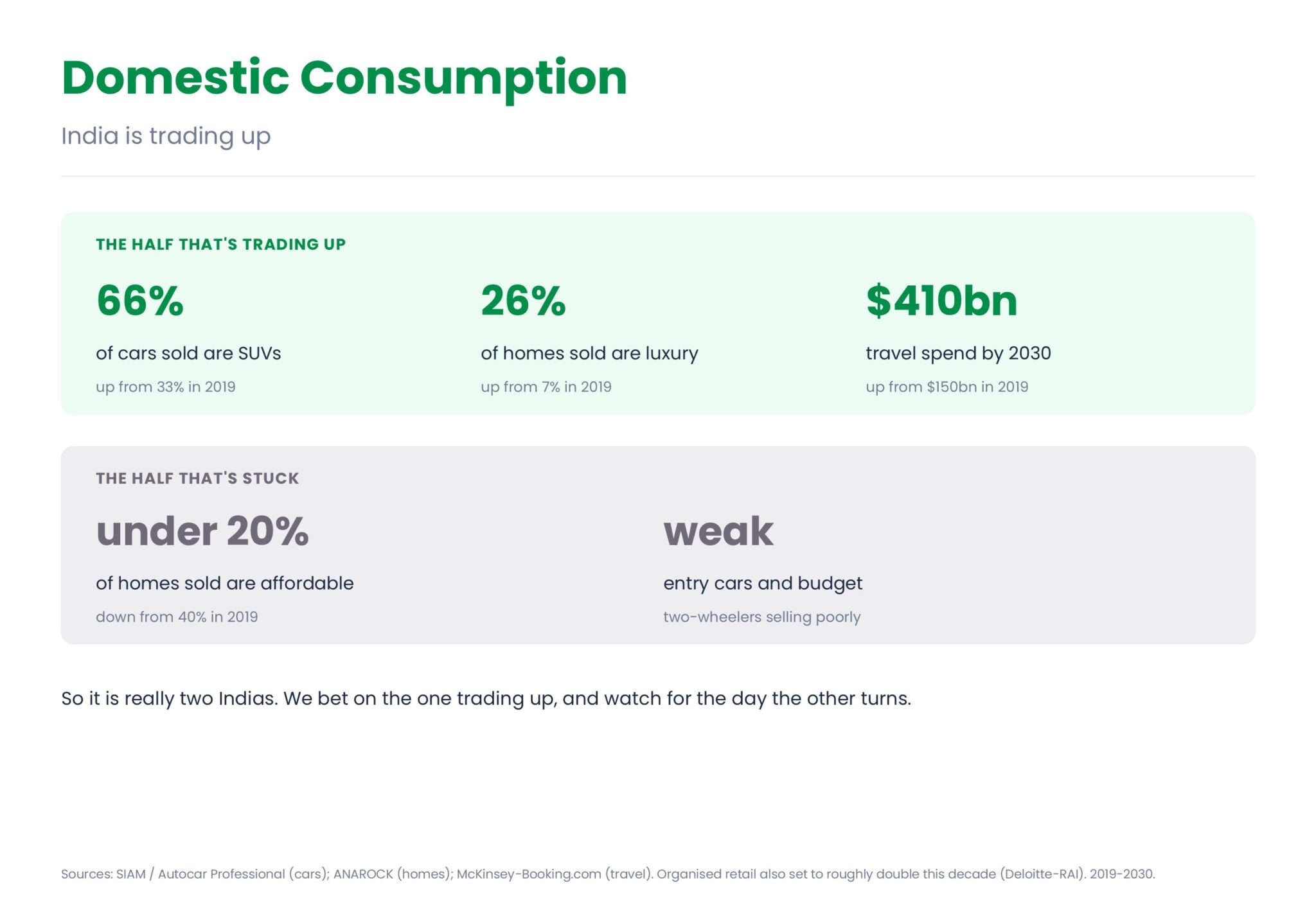
But here is the catch, and it is a real one. This is not happening for everyone. The top is doing well. The bottom is stuck.
Affordable homes have fallen from about 40% of the market to under 20%. Small cars and budget two-wheelers are selling poorly. So it is a K-shaped economy, and we are betting on the half that is moving up.
Kishore Biyani breaks this down nicely on the WTF podcast, splitting India into three consuming classes.
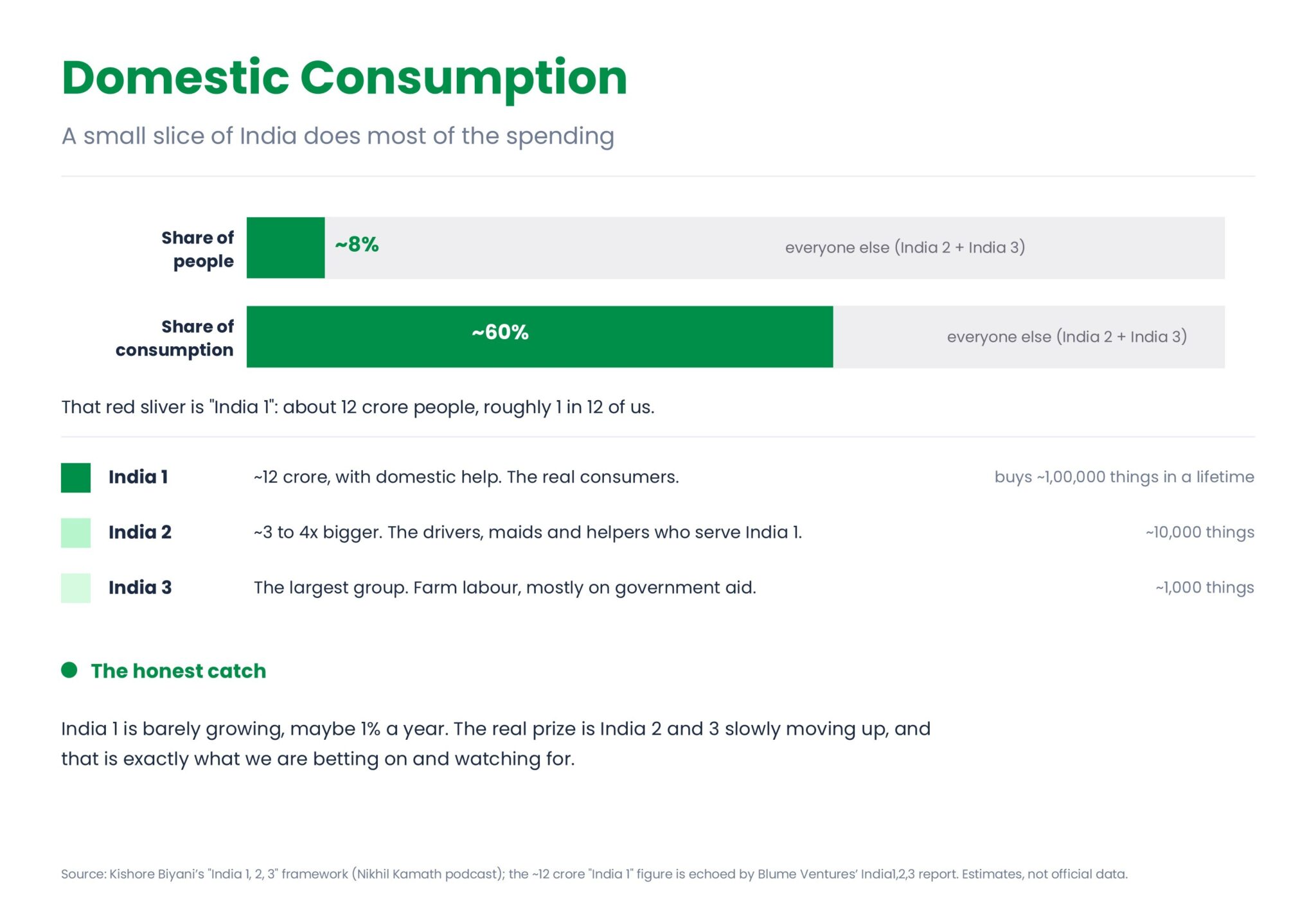
For the next five years, we are betting that the top spending population keeps growing. More well-off families, more credit cards, more spending on wants. The day the bottom picks up, it gets cheaper and gets interesting too.
2) Import Substitution
For years, if India wanted something good, we imported. Phones, electronics, a lot of defense gear. That is changing fast.
- Ten years back, 75% of the phones Indians bought were imported. Today that is near zero; almost all of them are made here, and India is the world’s second-largest phone maker. Mobile exports have gone from about ₹1,500 Cr to ₹2.6 lakh Cr in the last 10 years.
- Electronics output has gone up 6x, from ₹1.9 lakh Cr to ₹11.3 lakh Cr a year, and the plan is to reach about ₹47 lakh Cr by 2030 (the official target is $500 billion).
- Defense is the same story. India’s arms imports fell about 9% over five years, and we stopped being the world’s biggest arms buyer. Our dependence on Russia halved, from 72% of imports to 36%. Meanwhile, 75% of the defense procurement budget is now reserved for Indian companies. Domestic defense production hit a record ₹1.5 lakh Cr, and exports jumped 34x in a decade, from under ₹1,000 Cr to over ₹23,000 Cr. We used to only buy weapons. Now we sell some too.
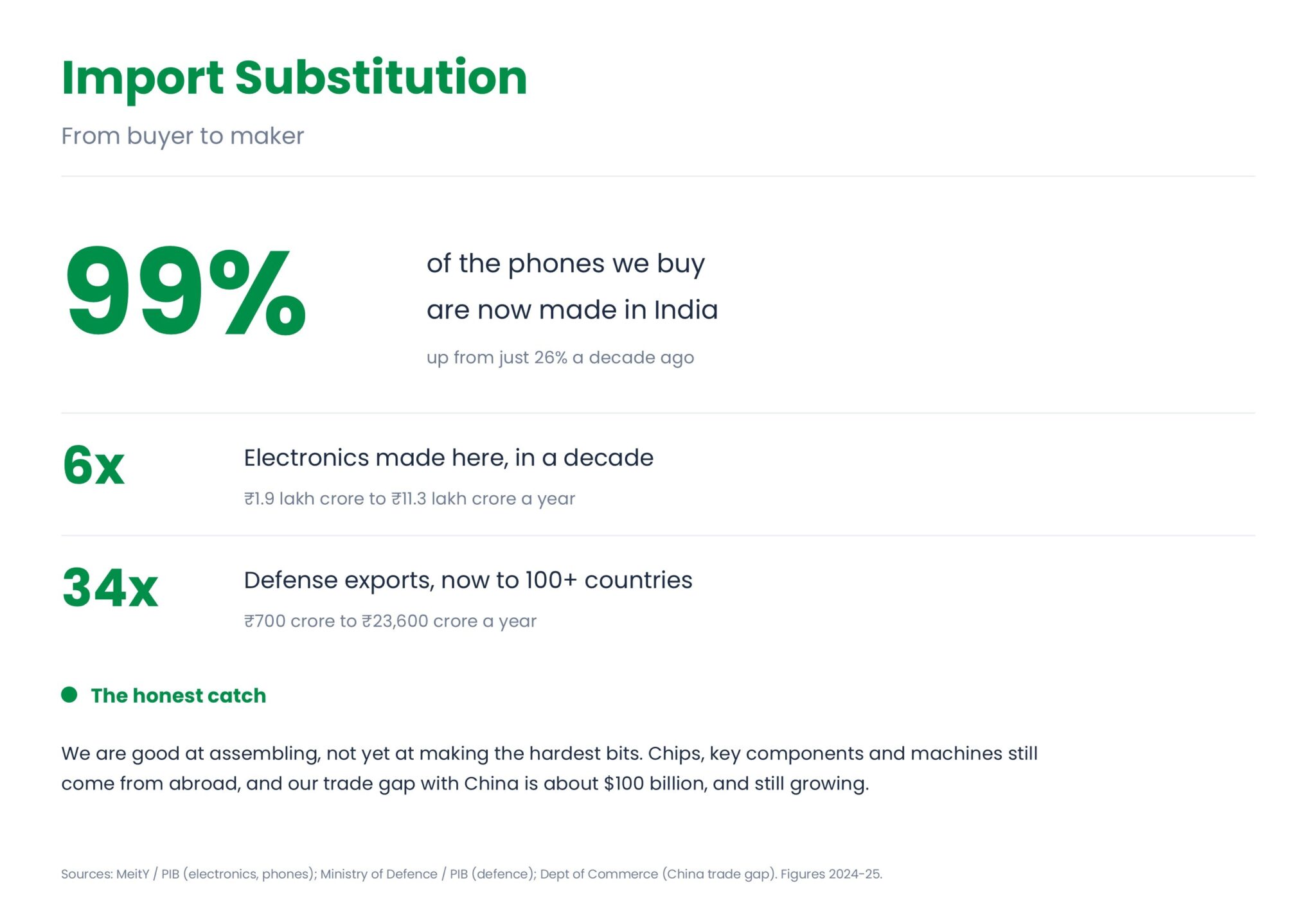
Surge India invests in this “Import substitution” theme across the companies making the final product and the ones making the machines and parts that go into it.
Now, the not-so-happy part (or shall we call it the next opportunity?) is that while we are good at assembling, we are not yet there when it comes to manufacturing the hardest bits. The chips, the key components, the advanced machines, those still come from abroad. Our trade gap with China is about $100 billion and still growing. So this is a long climb. The next five years are about moving from assembly to actual manufacturing, and this is where the real opportunity lies.
3) Energy Independence
We import almost 90% of our crude. Nothing changes that in a hurry, and it shows up in the import bill every year.
Power is where it gets interesting. In 2025, more than half of India’s power capacity turned clean. The target was 2030. We got there five years early.
One catch. Capacity is what you own, not what you use. Solar works five or six hours and clocks off; coal does the night shift. So half our capacity being clean still leaves about three-quarters of our actual electricity coming from coal.
More panels won’t fix that. The problem was never panels, it’s sunset. Batteries fix it, and that’s the part to watch: Storage goes from almost nothing today to a planned 208 GWh by 2030.
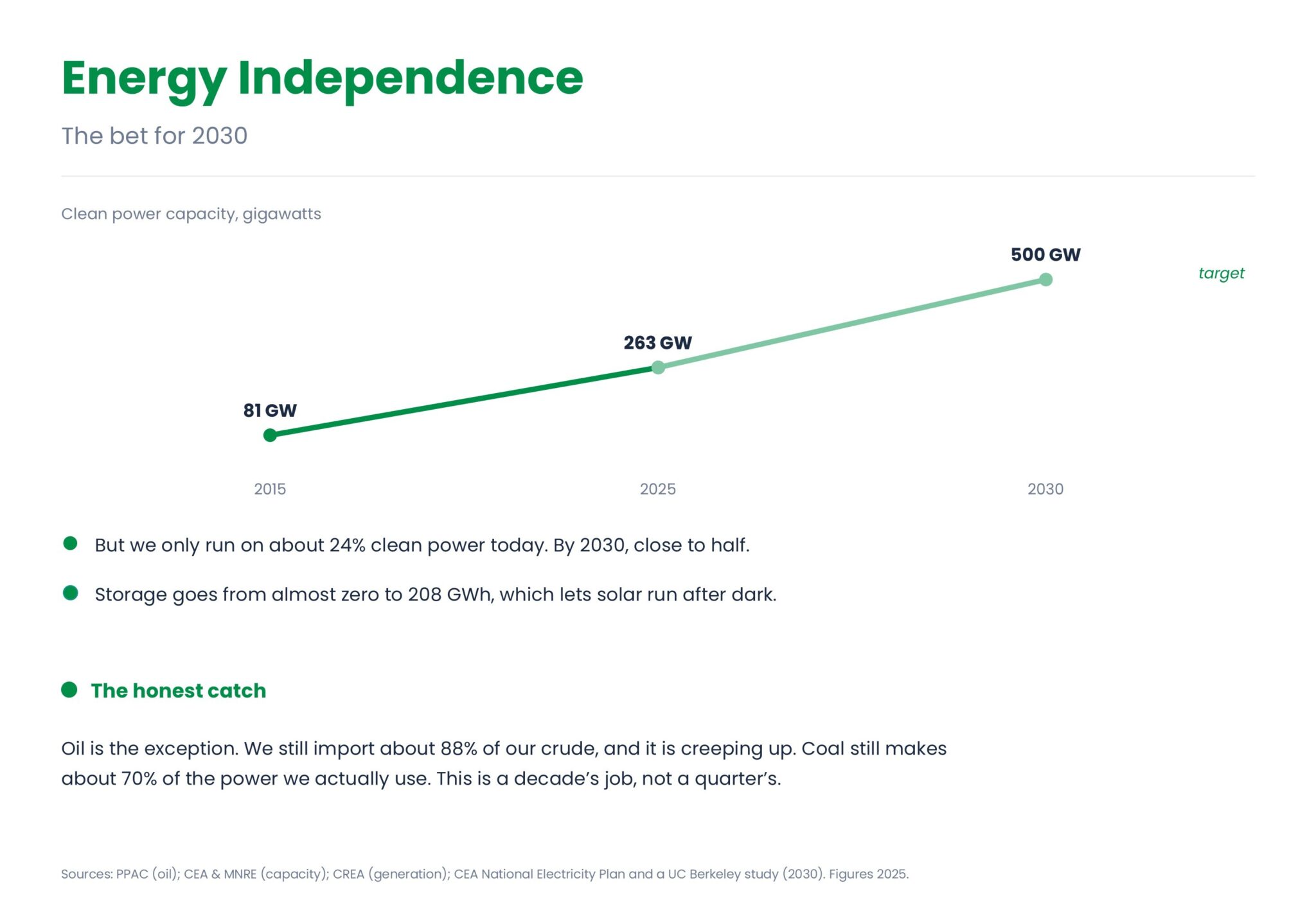
That gap is the bet, and the next 5 to 10 years are about closing it. Capacity goes from 263 GW today to a planned 500 GW by 2030. But the number that matters more is usage. Clean power is about 24% of the electricity we actually use today and is projected to be roughly 50% by 2030.
Why bet on it? Because first, we don’t have a choice, and second, the costs are coming down. Solar was ₹12 a unit in 2010, but about ₹2.5 today. Storage is falling the same way. Battery storage bids have dropped from approx. ₹10 a unit in 2022 to approx. ₹3.5 now, in just two years. Adoption at scale happens when the right things get cheaper. We are on that journey.
Surge India invests in the companies that help India achieve its energy independence. The EV players, battery storage, the ones building transmission lines and the grid, the ones making cables, wires, transformers and power equipment, etc.
4) Logistics and Infrastructure
Every growth story needs a backbone: roads, rail, ports, warehouses. For years, India’s infrastructure was weak, and that quietly made everything more expensive. That is being fixed now.
- Our railway network is 99% electric, which means less imported diesel.
- India now moves more goods by rail than any country except China. The freight corridors are done: 2,843 km of track meant only for goods trains, so they no longer have to wait for passenger trains to pass. Trains run twice as fast, over 50 km/h, and one double-stacked train carries what used to need 250 trucks.
- The government is spending heavily: ₹11.2 lakh Cr on infrastructure this year alone, heading toward 5% of GDP by 2030.
- As all this comes together, the cost of moving goods, long stuck around 13-14% of GDP, is falling towards 8%.
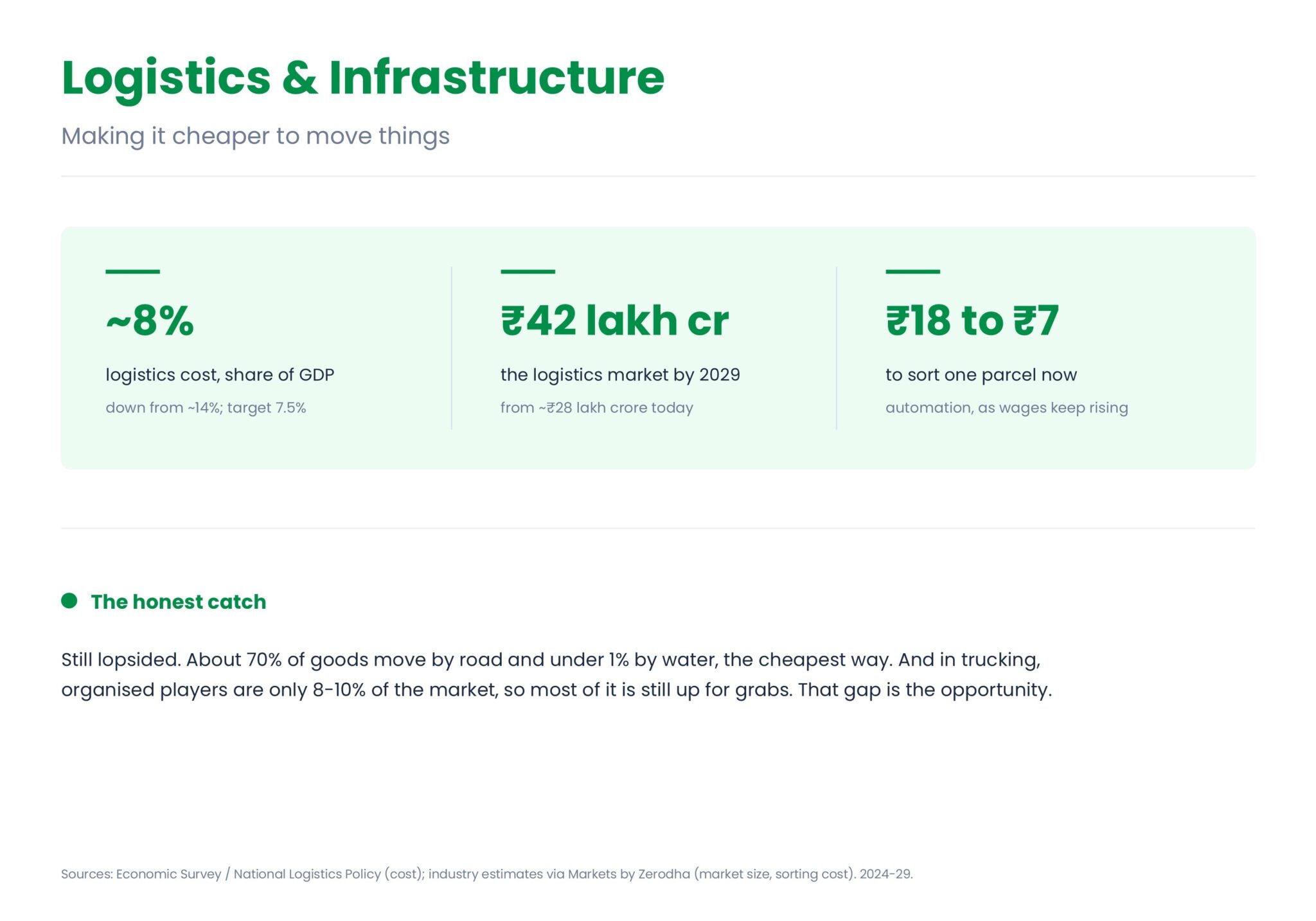
Surge India invests in the companies building this, from rail and road makers to warehouse and port operators.
Having said that, logistics in India is still lopsided. About 70% of our goods still move by road, the costly way, and under 1% by water, the cheapest way. The backbone is being built, but much of the innovations, and savings, are yet to come. Let’s see what happens, but for now, we remain bullish.
5) Financialization
For most of our lives, Indians kept their money in three things: cash (savings), gold, and real estate. That is slowly changing. People are increasingly putting money into the capital markets.
The numbers are striking.
- Demat accounts went from ₹4 Cr in 2020 to ₹24 Cr as of Oct 2026.
- Every month, about ₹32,000 Cr flows into mutual funds through SIPs
- Mutual fund AUM have crossed ₹80 lakh Cr, about a quarter of the whole economy.
- For the first time in over 20 years, Indians own more of their own market than foreigners do. (We’re not saying it is good or bad. That’s still debatable. But the shock absorber speech by FM has become the talk of the nation.)
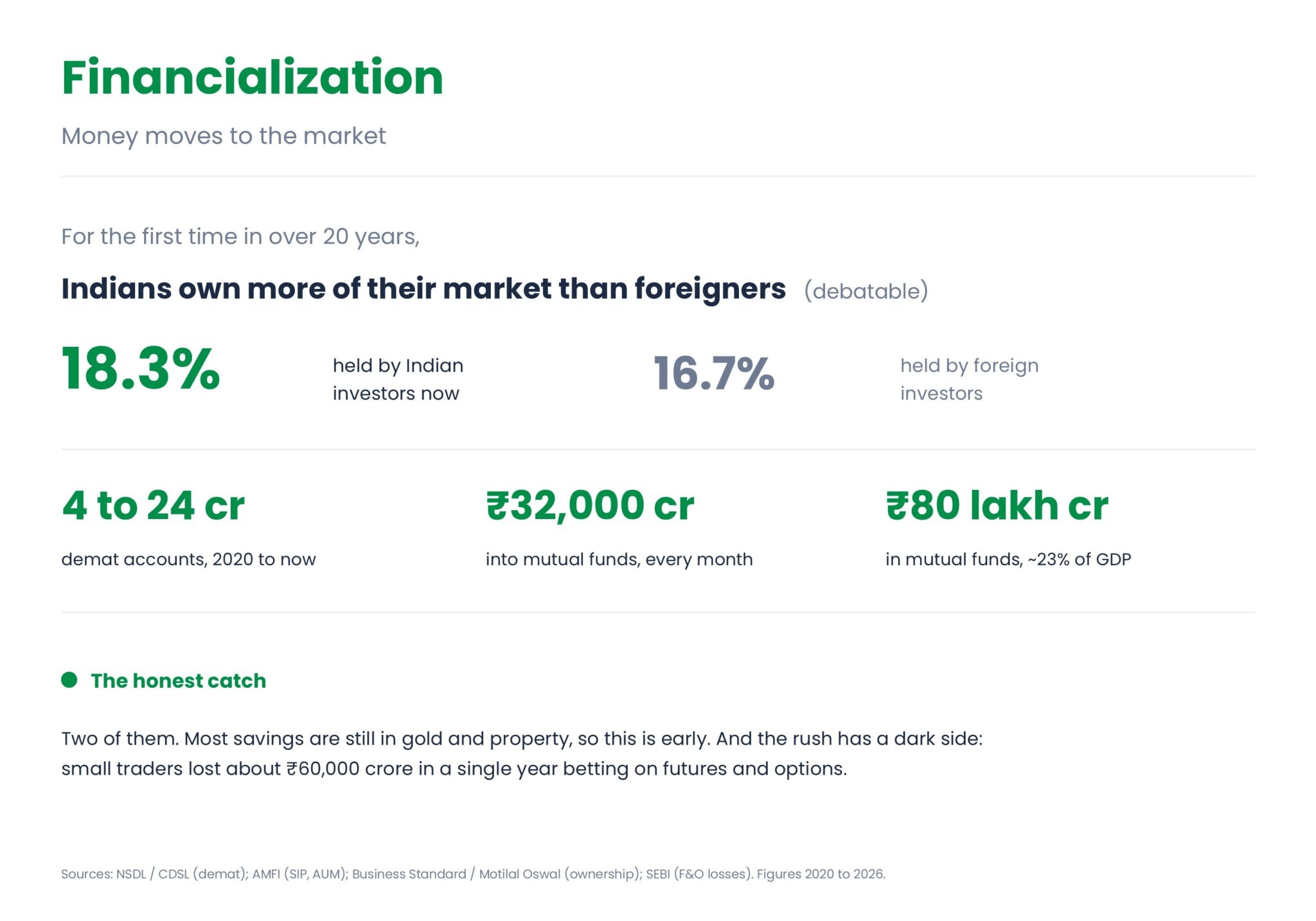
We invest in the businesses running this shift: the banks, the insurers, the fund houses, the exchanges.
Most savings are still in gold and property, so this has a long way to go, and the rush has a dark side. Small retail traders lost about ₹60,000 Cr in a single year betting on F&O. More people investing is good; more people gambling is not. The regulators also understand this and hence once in a while discourage too much speculative participation of retail investors in the market. That is the key risk, though.
Putting It All Together
Put the five themes together, and we are looking at growth at scale. What Indians earn, what they buy, what we make instead of import, the power that runs it, and the savings that fund it. Each one is a decade-long shift on its own. The real force is that they feed each other.
Factories need power and roads. Cheaper power and better roads make those factories competitive. Rising incomes buy what they produce, and the savings left over come back into the market and pay for the next round of building.
We have managed real money on these themes for nine years in Surge India, through a crash, a boom, and the sulk we are sitting in today. This is the strongest setup we have seen for owning Indian businesses, on the back of strong earnings and favorable valuations. As of mid Nov 2026, we manage ~₹700cr in our Surge India investment approach and remain very bullish on the portfolio as India’s growth story takes better shape.
We end this article with a simple statement which forms the crux of Surge India’s investment thesis:
Believe in market cycles; believe in India’s growth.
Reference
- India 1,2,3 by Kishore Biyani How Ultra-Rich Indians Spend Their Money - Kishore Biyani Explains India 1, 2, 3
- Oil & power (PPAC, CEA/MNRE, 2030 plan, storage study, costs)
- Manufacturing (electronics, defense, China trade gap)
- Consumption (cars, homes, travel, retail)
- Infrastructure (roads, rail, logistics cost, capex)
- Markets (ownership, demat, F&O losses)
Related Posts
 Where do Superhero stocks come from?
Anoop Vijaykumar
 Five perils of momentum investing you cannot ignore
Anoop Vijaykumar
 Should you invest at market highs?
Anoop Vijaykumar
 Does Your Retirement Portfolio Have Room for Error?
Akanksha Maulik
Make your money work as hard as you do.
Talk to a Capitalmind Client AdvisorInvesting is not one size fits all
Learn more about our distinct investment strategies and how they fit into your portfolio.
Learn more about our portfoliosUnlock your wealth potential
Start your journey today