(category)General
Investing Abroad Through a PMS: The Infrastructure that CountsInvesting Abroad Through a PMS: The Infrastructure that Counts
What actually happens to your money and your holdings when a PMS invests abroad, and what’s still being worked out.
Avijeet Sen•

In our last piece (you can read it here), we walked through what a PMS can now build with foreign securities (fund/ETF baskets, active portfolios, feeder funds), how the tax rules differ based on what you invest in, the estate tax exposure if you invest in US-situs assets, and the LRS ceiling. This article tackles the “behind-the-scenes” operations of making all this work.
Buying a US ETF or an Irish UCITS fund is the easy part. Owning it in a way that fits how a PMS is supposed to work in India is where things get complicated. To see why, it helps to start with how a PMS holds your Indian investments today.
How a PMS Holds Securities Today
When you onboard with a PMS, the portfolio manager doesn't take your investments onto its own books. Everything it buys for you, whether shares or mutual fund units, sits in a demat account opened in your name. You are the owner. The PMS only has the authority to trade on your behalf (usually through a power of attorney you sign at onboarding).
That demat account lives at one of India's two depositories, NSDL or CDSL. These are the central registries where Indian securities exist in electronic form. A share of Reliance and a unit of a Nifty index fund held in demat form are, in the end, both entries in one of their ledgers.
Between you and the depository sits a custodian. This is a SEBI-registered entity that operates the demat account, settles trades, tracks corporate actions like dividends and bonus issues, and reconciles what you hold. That covers mutual fund units as much as shares. Custody isn't optional for a PMS. The regulations require the PMS to appoint one.
Then there's the broker, who executes trades on the exchange. The broker and the custodian are different legal entities, even when they share a brand name. ICICI Securities is a broker. ICICI Bank is a custodian. Same logo on the letterhead, separate companies with separate SEBI registrations.
Why the Split Matters
The PMS makes the investment calls and executes the trades via a broker, but neither of them holds your securities. That job belongs to the custodian, which answers to SEBI on its own. No single party controls both the decision and the asset.
This setup protects you if the PMS itself goes bust. Your securities were never on its books. They're held in your name, in a demat account the custodian operates, so that the PMS's creditors have no claim on them.
It also gives you a clean exit. If you leave your PMS, your shares and fund units don't have to travel anywhere. They're already in your name, at a depository, with an independent record of what you own.
This whole setup was built for securities that live inside India's depository system. A US-listed ETF or a UCITS fund domiciled in Dublin doesn't. NSDL and CDSL can't hold them. So when a PMS buys a foreign security for you, who holds it, and in whose name?
Where Foreign Securities Fit
The new PMS regulations allow a PMS to invest client money in foreign securities in the manner SEBI specifies. The regulations themselves only take effect from 1 April 2027. What follows is our reading of the regulatory text as it stands, not a settled answer.
Three regulatory provisions do most of the work:
- Regulation 16(2) says a PMS can't carry out its investment management operations, or execute transactions, outside India. There's one exception: trades for investment in foreign securities. So a PMS can use a broker abroad to buy foreign securities for you. It doesn't necessarily have to route the order through an Indian broker (and an Indian broker would, in any case, would typically pass the order on to a partner abroad to actually execute it).
- Regulation 19 says every portfolio manager, other than one that only gives advice, must appoint a custodian for the securities it manages. There's no carve-out for foreign securities. A US ETF or an Irish UCITS fund in your portfolio needs a custodian just as much as your Reliance shares do.
- Regulation 17(2)(a)(v) bars a PMS from holding the securities in a client’s portfolio in its own name, whether by contract with the client or otherwise. This one matters most once we get to custody.
The Self-Custody Problem
This is where Indian rules and foreign practices stop lining up. In India, the broker trades and the custodian holds the securities. That split isn't universal. In markets like the US, it's normal for a broker to hold client securities, and some large global brokers don't work with independent custodians at all.
For an individual investing on their own, that's perfectly fine. Most people with a US brokerage account hold their shares exactly this way. For a PMS bound by Regulation 19, the question is whether a foreign broker that also holds securities can qualify as the required custodian. SEBI’s PMS regulations require the appointment of a custodian. Whether a foreign broker's own safekeeping arrangements can satisfy this requirement is something SEBI will need to clarify.
Four Ways to Think About It
Put the two choices side by side: an Indian-registered broker or a foreign one, and a separate custodian or the broker holding the securities itself. That gives a simple grid.
| Separate custodian | Broker holds the securities | |
| Indian-registered broker | Meets Regulation 19 | Doesn’t meet Regulation 19 on our reading |
| Foreign broker | Meets Regulation 19 | Doesn't meet Regulation 19 on our reading |
Our reading of Regulation 19 of SEBI PMS regulations is that the broker can sit in India or abroad, but the PMS must separately appoint a custodian. A broker simply holding securities as part of its brokerage service doesn’t satisfy that requirement. That leaves two models that meet Regulation 19, both in the left column. As we’ll see, meeting Regulation 19 isn’t the end of the story.
SEBI's pending operating framework on how a PMS should handle foreign securities could still change this. SEBI might, for instance, decide that a regulated foreign broker's own safekeeping is good enough for foreign securities. Given how widely that model is used abroad, it wouldn’t be an unreasonable outcome. But until SEBI sets out that framework, nobody can say for certain which column the industry ends up in.
The Accounts You’d Open as a Client
You can’t escape paperwork if you want to invest in foreign securities via a PMS. You will need to open a few accounts as a bare minimum requirement. Here’s what we think those accounts are. Parts of it are still being finalized, and SEBI’s operating framework may change more.
- The dedicated bank account for foreign investing
In the operating model we're considering, the client opens a dedicated bank account in their own name, used only for their foreign investments via the PMS. Typically, the appointed custodian operates this account, and the client gives the PMS a power of attorney so it can instruct the custodian to move money into and out of it, for investing and for redemptions. Where exactly the bank account sits, whether in GIFT City or overseas is something your PMS will decide depending on which broker/custodian partner they choose. The client may also need to sign an agreement with the custodian, since the custodian runs the dedicated bank account in their name. This part isn’t settled yet, and as we explain in the rest of this article, it may turn out to matter more than it looks.
From an operational perspective, the client funds the dedicated foreign-investing bank account from their Indian bank account. That's the moment LRS kicks in, because the money is leaving India. A GIFT City bank account counts as “outside India” for this purpose. Checking the LRS limit and collecting TCS (Tax Collected at Source) is the job of the client's bank (the authorized dealer, or AD bank, that handles the remittance), not the PMS. The PMS doesn't track how much of a client's LRS limit has gone on travel, a child's college fees, or anything else.
- The brokerage account
The client also opens a brokerage account (in their own name) with the broker partner the PMS has chosen for executing trades in foreign securities. When there's something to buy, the PMS instructs the custodian to move money from the dedicated bank account to the client’s brokerage account and then places the trade. The PMS never handles the money itself, which is how it already works for Indian portfolios. And because the money left India under LRS on its way into the dedicated account, this onward move doesn't count against the limit again.
International Custody: The Big Difference Versus Domestic Portfolios
While the brokerage account is in the client's name, custody is a different story. The custodians a PMS would use abroad are institutional custodians, set up to serve fund managers and banks rather than individuals. Most won't open a thousand custody accounts for a thousand PMS clients (the cost alone usually rules it out). What they typically offer is one pooled account for the whole PMS.
So trades are executed and recorded against each client's brokerage account, while the securities settle into a pooled custody account, commonly called an omnibus account, holding everyone's investments. Such an account can be structured to hold securities on behalf of multiple clients without the PMS necessarily being their legal owner. The broker maintains the client-level transaction history, while the PMS maintains records of what each client owns. The custodian, meanwhile, sees only the aggregate holdings. It knows the PMS's clients collectively hold, say, 4,000 units of a particular ETF, but not how those units are distributed among individual clients.
By Indian standards that split is unusual, since in India both the trade and the holding sit in the client’s name. On a plain reading of the regulations, it’s more than unusual.
- Regulation 17(2)(a)(v) bars a PMS from holding client securities in its own name, whether by contract or otherwise. An omnibus account need not necessarily be held in the PMS's name, so whether this provision is breached depends on how the custody account is legally structured. If the PMS itself is the named holder, the arrangement would appear to conflict with the regulation.
- Regulation 16(8) separately requires each client’s holdings to be kept in separate accounts. A pooled account doesn’t sit with that test however carefully the PMS keeps its own records.
The obvious fixes don’t get around this. A separate custody account for every client would satisfy the regulations, but institutional custodians typically won’t offer it at PMS scale. Letting the broker hold the securities in each client’s own brokerage account would keep everything in the client’s name, but on our reading, it doesn’t meet Regulation 19’s requirement for a separate custodian. So every option currently fails one test or the other:
| Fits the regulations? | Works in practice? | |
| Separate custody account per client | Yes | Global institutional custodians probably won’t offer |
| Pooled custody account | Not under 16(8)
Potentially also 17(2)(a)(v), depending on pooled account ownership/structure |
Yes, with gaps (explained in the next section) |
| Broker holds securities in the client’s account | Not under Regulation 19, on our reading | Yes, and simplest |
The last option keeps holdings in the client's name, which is what Regulations 16(8) and 17(2)(a)(v) exist to protect. Yet, on our reading, that's precisely the option Regulation 19 rules out.
How Reconciliation Changes with Pooled Custody
For Indian securities, reconciliation is a daily routine. Every day, allowing for settlement timings, the PMS back office checks what each client holds against their demat records. So a PMS always knows holding details for every client on a daily basis. When a rebalance comes around, the trade sheet (at a client level) is built from those reconciled holdings. If client A holds 10 shares of Reliance, the trade sheet can't sell 11.
Foreign securities need the same discipline, but built in a different way. The PMS back office maintains its own client-level holdings records based on the trades executed for each client. These are checked daily against the client's brokerage statement, which independently records every buy and sell made on their behalf. Rebalancing trade sheets are then generated from the reconciled holdings, just as they are for Indian securities.
If pooled omnibus custody becomes the operating reality for foreign securities, then on top of the above comes a second daily check, again allowing for settlement timings (US trades, for instance, settle a day after they're done). The custodian's statement shows the consolidated holding of each security across all of the PMS's clients. The back office adds up its client-level records and matches the total against that statement, so any aggregate mismatch shows up before the next trade goes out.
The two checks serve different purposes. Matching the PMS's total holdings against the custodian's statement confirms that the securities are present, but doesn't necessarily confirm who owns how much. For example, if one client is incorrectly credited with 10 extra ETF units and another with 10 fewer, the total would still match. That's why the client-level records also need to be independently checked against each client's brokerage transactions, not just against the custodian's aggregate holdings.
Corporate actions are where this breaks down. In India, when a company declares a dividend, a bonus or a split, the custodian credits it to each client’s own demat account. That credit is an independent record of what each client received. In a pooled custody account, the custodian credits the PMS’s total holding across its clients. These corporate actions may or may not appear on the client's brokerage statement either, because the securities are held with the custodian rather than the broker. So the PMS needs to work out each client’s share from its own records, and the only check is that the shares add up to the total. A wrong allocation between two clients would pass that check unnoticed.
That makes the PMS both the allocator and the only record of what each client owns after every corporate action. That’s the position the regulations’ segregation and custody rules exist to prevent. The more corporate actions a portfolio sees, the further its client-level records drift from anything independently verified.
The knock-on effects add up. Fractional entitlements leave residues that need a rule of their own. Dividends have to be split and paid out to each client’s dedicated account. And the tax reports clients depend on in the next section can only be as accurate as the PMS’s allocation.
Cash needs the same daily attention as securities. Client money sits in the dedicated bank account and at the broker, and moves between the two, so the back office reconciles each client's cash balance as well. A rebalancing trade sheet is only as good as its knowledge of how much cash each client actually has.
Making the Tax Season Manageable
Foreign securities add work to a client's tax return, and most of it lands on whoever files it. So a PMS investing abroad has to produce transaction and holdings reports detailed enough for the client's CA to file the annual return, foreign asset disclosure included, without chasing statements from three different places.
Capital gains and dividends go into the return on the usual April to March financial year. Every sale needs dates, quantities, cost, and proceeds, converted into rupees. Every dividend needs the gross amount, the foreign tax withheld, and the net received, so that the client has the information needed to claim foreign tax credit, where eligible, including filing Form 67.
Then there's Schedule FA, the part of the return where residents disclose their foreign assets. It runs on the calendar year, January to December, not the financial year. The information required depends on the type of asset or account being disclosed. For foreign equity holdings, this can include the initial investment value, the closing value on 31 December, and the peak value during the calendar year, converted into rupees using the prescribed exchange rates. Holdings sold during the year still have to be disclosed. Working out peak values can mean tracking each holding's value throughout the year to identify its highest value, which is exactly the kind of thing a CA shouldn't have to rebuild from raw statements. Schedule FA also asks about foreign accounts, at the account level, so a brokerage account held overseas would likely need its own entry too.
So the reports have to work on two calendars: a financial-year view for income and gains, and a calendar-year view for Schedule FA, with peak values worked out holding by holding. Each client's brokerage statement shows their trades, but dividends and corporate actions may land in the pooled custody account. In the pooled custody model, the PMS is the only party with the complete picture of what each client owned and earned. As the SEBI-registered entity managing the money, it's also the one accountable for getting this right, so the job falls naturally to it.
Leaving the PMS
Earlier, we said that if you leave your PMS, your Indian holdings don’t necessarily have to be sold in order to be moved to you, because they’re already in your name. For foreign securities, how far that holds depends on which custody model wins out.
In a pooled account, it doesn’t hold. Your brokerage account and your trade history are yours, but the securities sit in an account shared by all of the PMS’s clients. If you leave, one possible route is for the PMS to sell your foreign holdings, with the proceeds going back to your dedicated account and from there to your bank account in India. Whether the securities can instead be transferred to another account without being sold is still to be worked out.
Selling comes with a tax cost. If selling is the only practical way out, you may have to realize capital gains just to change portfolio managers, which you wouldn’t have to do with an Indian portfolio. It’s another way pooled custody falls short of what the regulations are trying to protect: your ownership of your securities, independent of the PMS.
The other two models handle this better. With a separate custody account in your name, or with the broker holding the securities in your own brokerage account, your foreign holdings would already be in your name, and leaving could look much more like it does today.
Putting it Together
Here’s how the money and the securities would move under the model global custodians typically offer today. It’s illustrative, based on our reading of the regulations, and subject to SEBI’s operating framework.
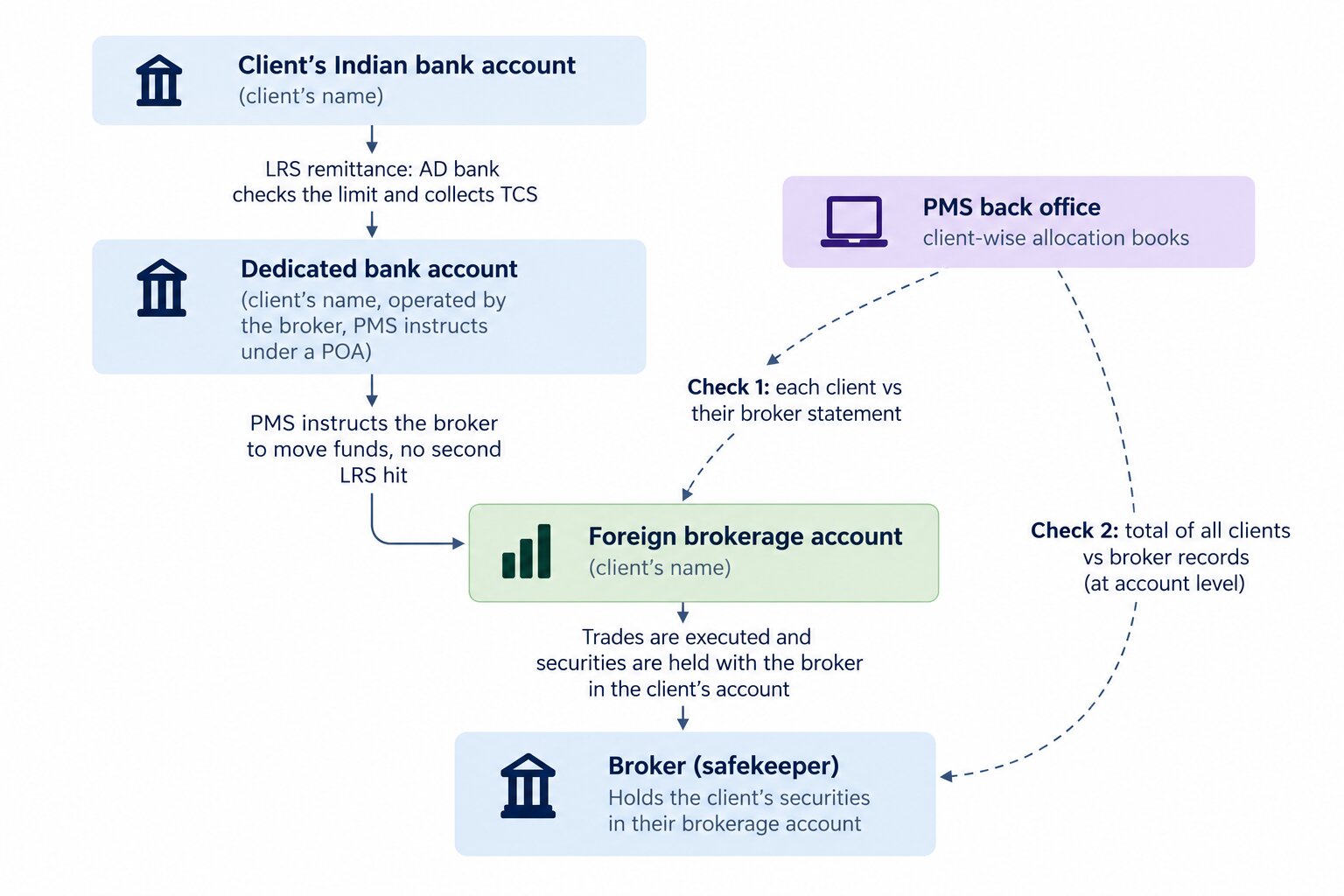
Up to the last box in the above flow, the model fits the way a PMS is meant to work. The money moves through three accounts in the client’s name, and every trade is booked in the client’s name too. The trouble starts where the securities settle. A pooled custody account is what the global custody market typically offers, but it sits uneasily with Regulation 16(8) and could also conflict with Regulation 17(2)(a)(v) if the securities are held in the PMS's own name. It also leaves corporate actions without an independent client-level check, and it makes leaving the PMS harder. Each alternative in our table fails a different test. That last box is the problem SEBI’s operating framework needs to solve.
However, if SEBI’s framework decides that a regulated foreign broker’s own safekeeping meets Regulation 19, the flow stays the same except for the last step. The securities never leave the client’s brokerage account, so there’s no pooled custody account at all.
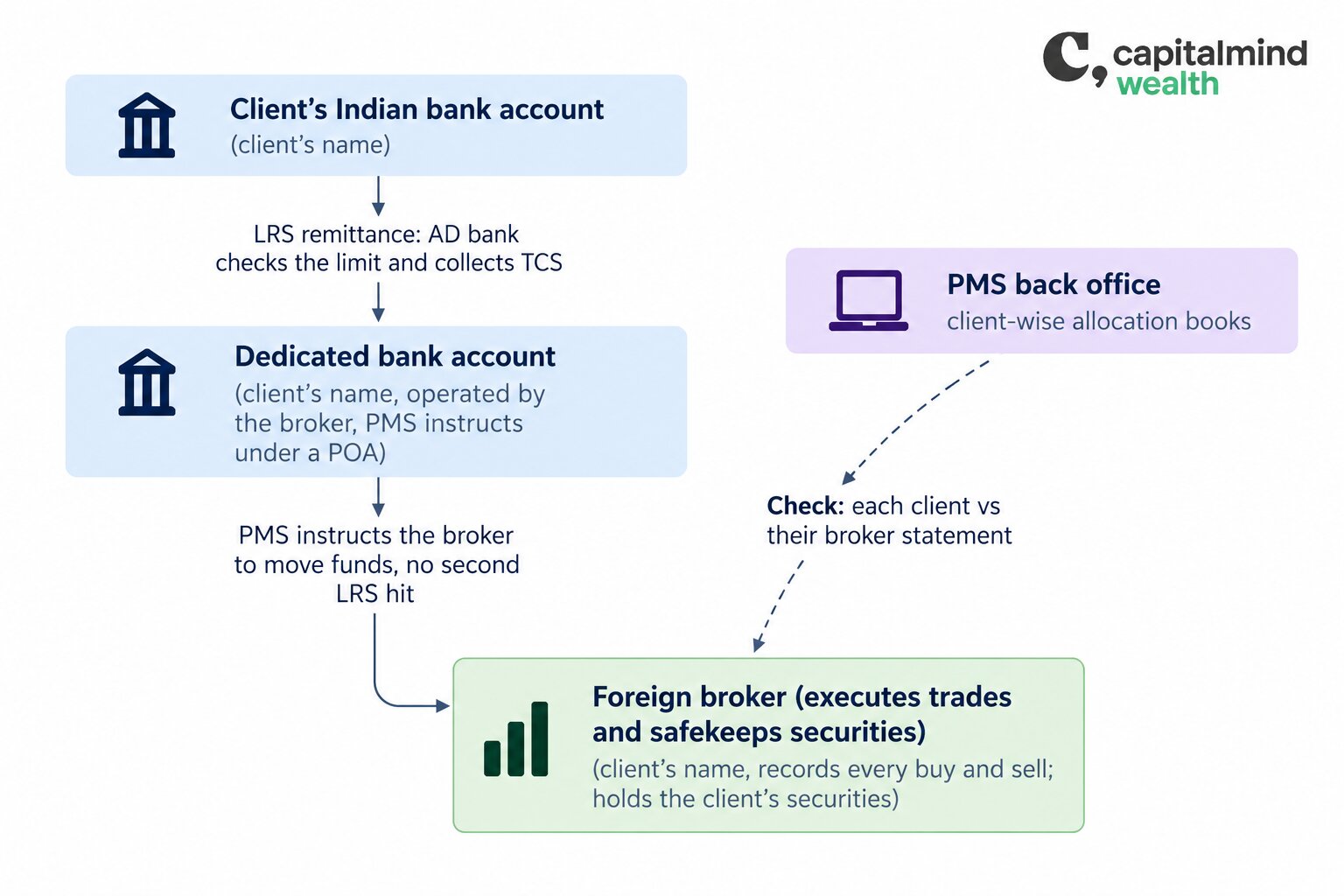
That fixes most of what this piece has been worried about. Your holdings sit in your name, which is what Regulations 16(8) and 17(2)(a)(v) are after. Dividends and corporate actions are credited to your own brokerage account, so your statement becomes an independent record of what you own, much like a demat statement. The PMS reconciles against one statement per client, and leaving the PMS need not necessarily involve selling the securities.
Capitalmind Wealth’s View
On our reading, current the regulations require a separate custodian for every security a PMS manages, foreign ones included, and that rules out brokers that safekeeping client securities themselves. It isn’t a judgement on either model. Large amounts of money around the world sit with brokers who safekeep client securities, and it’s a well-established way of operating.
The difficulty is what that leaves. A separate custody account for every client fits the regulations, but institutional custodians don’t typically offer it at PMS scale. T- the cost alone would rule it out. A pooled custody account is what they do offer, but it sits uneasily with Regulation 16(8), and may also conflict with Regulation 17(2)(a)(v) depending on whose name the securities are held in. It also leaves corporate actions without an independent client-level check. As things stand, every option fails one test or the other.
If SEBI allows it, broker safekeeping comes closest to what the regulations are trying to protect. Holdings stay in the client’s name, corporate actions land in the client’s own account, the brokerage statement works much like a demat statement, and leaving the PMS doesn’t force a sale.
So we’d like SEBI’s operating framework to answer a few questions clearly: whether a regulated foreign broker’s own safekeeping can count as custody for foreign securities, whether a pooled custody account can ever meet the segregation and own-name rules, and how a client exits with their foreign holdings. For investors, those answers matter more than the choice of any particular PMS with their broker or custodian.
What’s Next
The regulations take effect from 1 April 2027, and SEBI is yet to set out how foreign investing through a PMS should work in practice. Until it does, Capitalmind Wealth is working with partners to understand and work out the operating reality of both routes illustrated in this piece, so that we are ready whichever way the framework lands. What we won’t do is launch on a structure that doesn’t fit the regulations as written. When SEBI sets out its framework, we’ll revisit this piece and update whatever changes.
Related Posts
 Elections and Volatility. What now for investors?
Deepak Shenoy
 Growth Investing In India: A Quantitative Approach
Divyansh Agnani
 PMS Explained: Professional Management with Direct Ownership
Akanksha Maulik
 Execution as an Asset Class: Why Institutional Order Routing and Timed Rebalancing Matter
Akanksha Maulik
Make your money work as hard as you do.
Talk to a Capitalmind Client AdvisorInvesting is not one size fits all
Learn more about our distinct investment strategies and how they fit into your portfolio.
Learn more about our portfoliosUnlock your wealth potential
Start your journey today