(category)General
The Shadow Portfolio: How Tax Anchors and Mental Accounting Lock You into InactionThe Shadow Portfolio: How Tax Anchors and Mental Accounting Lock You into Inaction
Your legacy investments need the same care your core portfolio does. Read on to know how NDPMS can close the gap and why it might be the bridge your shadow portfolio needs.
Akanksha Maulik•
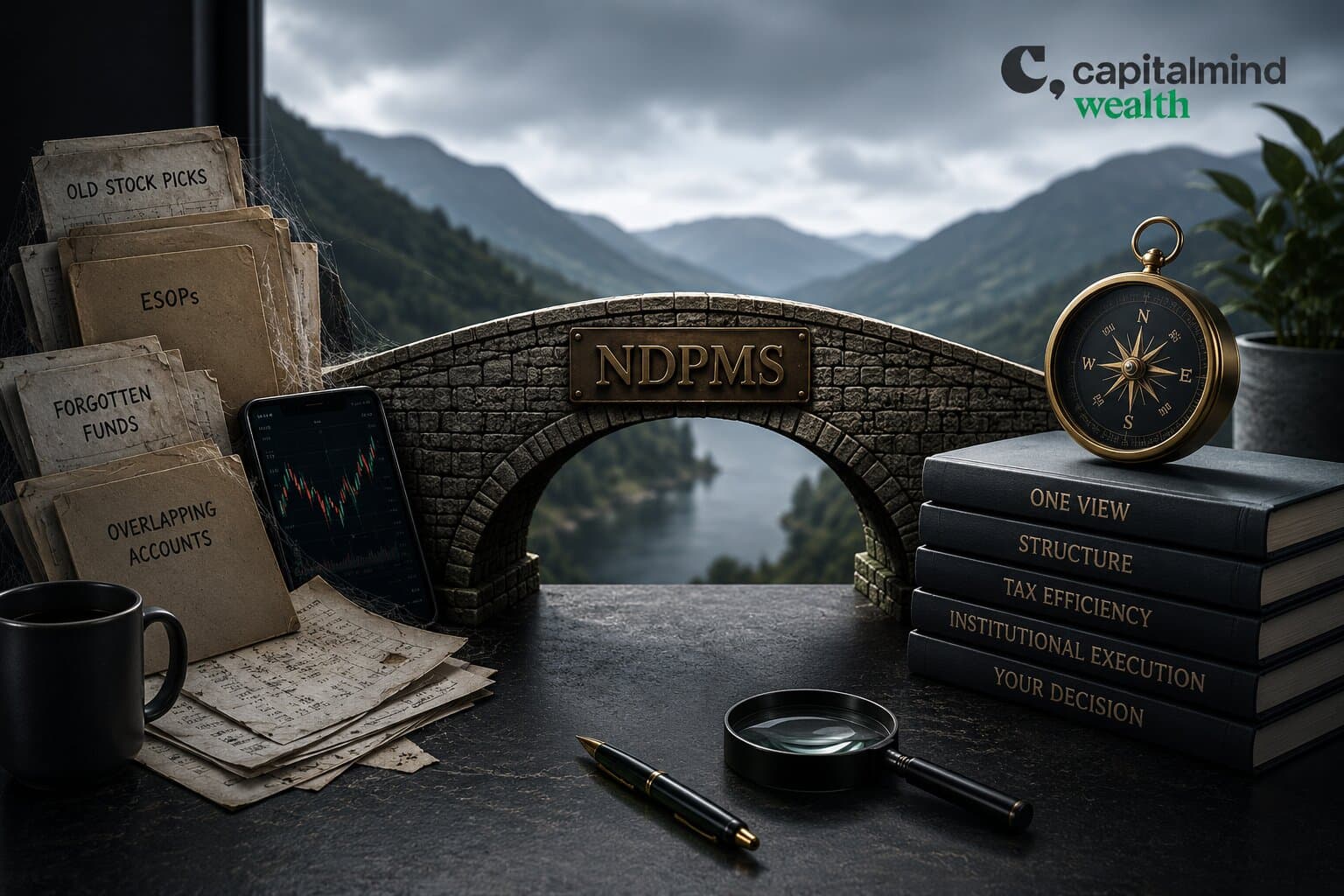
You've got a professionally managed core portfolio. Rebalanced, monitored, doing its job. And then there's the other portfolio: the one on the sidelines, which nobody manages and exerts a compounding toll on the portfolio.
Decade-old direct equities bought on a tip and never revisited, overlapping mutual funds that all do roughly the same thing, and forgotten ESOPs sitting in a demat account you've half-forgotten (and definitely forgotten the login for).
This shadow portfolio doesn't show up in your review, but it drags on your wealth anyway. Not necessarily because you made the wrong picks but just because you lacked the bandwidth to go back to them. Selling means a tax bill. Consolidating means relieving old decisions. So it just sits there.
This is a structural problem that NDPMS is built to close. Here's how the structure works, and why it might be the bridge your shadow portfolio needs.
The Behavioral Tax of the Shadow Portfolio
To understand why NDPMS is necessary, we must first examine the hidden costs of the self-directed shadow portfolio. The most significant drag on these legacy assets is not necessarily poor stock selection; it is the behavioral tax paid by the investor.
Investors who are brilliant and decisive in their respective professions often find themselves experiencing profound decision fatigue when managing their own legacy assets. Because these holdings are scattered across multiple retail brokerage platforms and direct mutual fund portals, the investor is forced to play the simultaneous roles of portfolio manager, tax accountant, and execution trader.
This fragmentation triggers a dangerous psychological trap known as mental accounting. Investors begin viewing their mutual fund portfolio in one bucket, their direct stocks in another, and their managed DPMS in a third. Because they lack a unified view, they become blind to their actual aggregated risk. We frequently audit self-directed portfolios only to discover that an investor holds twenty different mutual funds, believing they are highly diversified, when, in reality, those distinct funds are aggressively buying the exact same top-heavy large-cap stocks that the investor already holds directly.
Furthermore, managing a portfolio requires taking calculated actions during moments of extreme market stress. It requires trimming euphoric winners and rebalancing into equities during terrifying drawdowns. When you are managing your own shadow portfolio, the friction between knowing what to do and actually clicking the "Buy" or "Sell" button is immense. The cognitive load of these decisions eventually leads to paralysis, leaving portfolios stagnant, misaligned, and heavily overlapping.
The Trap of Tax Friction
Beyond behavioral biases, the greatest barrier to cleaning up a shadow portfolio is taxation. Many investors hold onto suboptimal stocks or overlapping mutual funds not because they believe in the future of the asset, but because they are terrified of the tax incidence.
Under a traditional discretionary mandate run on model portfolios, bringing these assets under professional management requires complete liquidation. Selling a decade-old portfolio of direct equities or legacy mutual funds triggers an immediate, often staggering, capital gains tax event. It forces the investor to realize gains all at once, severely eroding the compounding base of their capital.
Faced with this tax penalty, the investor chooses the path of least resistance: doing nothing. The legacy portfolio sits unmonitored, slowly deteriorating in quality, while the investor continues to focus their fresh capital entirely on new strategies.
Bridging the Gap: The Architecture of NDPMS
Our Non-Discretionary PMS is designed specifically to dismantle these behavioral and structural barriers. It is a bridge between the conviction of self-directed investing and the rigor of institutional oversight. We are shifting our role from simply being asset managers to becoming comprehensive asset allocators.
The mechanics are built around structural hygiene and tax efficiency. Rather than forcing liquidation, we open a dedicated NDPMS demat account for you. This allows us to accept your existing holdings—both direct stocks and direct mutual funds—via in-specie transfers. The assets move under our operational umbrella without triggering a single sale or taxable event.
Once the assets are consolidated, we start reviewing and transitioning the assets to DPMS in a tax efficient manner. For legacy assets that clear our performance and risk criterion, we maintain them in the NDPMS account and review them regularly for triggers. You retain 100% of the decision-making authority. We do not act without your explicit approval. Instead, we provide the institutional infrastructure operating through two distinct engagement layers, which is something your shadow portfolio has been lacking.
Layer One: Institutional Execution and Hygiene For some clients, the immediate need is simply an execution layer. Once your assets are consolidated, our operations desk takes over the administrative and execution burden. When you decide to deploy capital, run a systematic investment plan (SIP), or rebalance, we route the trades using institutional algorithms to minimize impact cost and slippage. We track your corporate actions, manage the cash drag of undeployed dividends, and handle the mechanics of execution. By separating your investment conviction from the administrative chore of trading, we eliminate the behavioral friction that so often leads to paralysis.
Layer Two: Strategic Review and Phased Migration For clients looking for deeper alignment, we step in as your portfolio co-pilot. Now that we have a consolidated, single-pane-of-glass view of your wealth, we can map the true territory of your exposures. We run regular institutional health checks across your total holdings, identifying redundancies, uncompensated sector bets, and dead-weight assets.
Together, we evaluate what should be held and what should be let go. Where appropriate, we design a deliberate, phased, and highly tax-optimized roadmap to transition your capital from unmanaged legacy holdings into actively managed DPMS strategies. We harvest tax losses where possible and spread capital gains realizations across multiple financial years.
Together, we transition your shadow portfolio from being a passive dead weight to actively managed investments complementing your core portfolio.
The Evolution of Control
Control should not require operational exhaustion. Retaining the final say over your wealth should not mean you have to act as your own execution trader, tax auditor, and risk manager.
After eight years of running discretionary mandates, we know that true wealth management is not about forcing an investor to surrender control; it is about empowering them with better data, clearer frameworks, and institutional execution. Our Non-Discretionary PMS ensures that your legacy assets are no longer treated as an afterthought. They are brought into the light, organized, optimized, and managed with the exact same rigor as your core wealth while the final decision always remains yours.
This is the first of three articles ahead of the launch of our new Non-Discretionary Portfolio Management Services (NDPMS). The other two articles explain why execution needs to be front and center and not an afterthought, and how a unified view of your investments brings clarity financial and tax reporting, respectively.
If you have a specific question for us, please feel free to reach out. Prospective clients can reach us at connect@capitalmindwealth.com. Existing clients can speak with their Relationship Manager or write to support@capitalmindwealth.com.
Disclaimer:
This marketing communication/document, in digital or print form, is issued by Capitalmind Financial Services Private Limited (“Capitalmind”) for informational and discussion purposes only and does not constitute a prospectus, disclosure document, offer document, research report, or legally binding representation. The information contained herein is based on sources believed to be reliable; however, Capitalmind and its directors, officers, employees, representatives, associates, affiliates, or group entities make no representation or warranty, express or implied, as to the accuracy, completeness, adequacy, or timeliness of such information. Nothing contained herein shall be construed as investment advice, research advice, or as a recommendation, solicitation, invitation, endorsement, or offer to buy or sell any securities, financial instruments, or portfolio management services. The content herein does not take into account the specific investment objectives, financial situation, risk appetite, or particular needs of any recipient. Any reference to specific securities, strategies, or asset classes is for illustration purposes only and should not be construed as a recommendation. There can be no assurance that the objectives of any strategy will be achieved. Investments in securities markets are subject to market risks, including potential loss of principal and fluctuation in portfolio value. There is no assurance or guarantee of returns or appreciation. Forward-looking statements, if any, are based on current assumptions and expectations and involve known and unknown risks and uncertainties that may cause actual results to differ materially. Recipients are advised to exercise independent judgment and undertake their own due diligence, including seeking independent professional advice from tax, legal, financial, and other advisors, before making any investment decision. Any decision taken based on this material shall be solely at the discretion and responsibility of the recipient. Capitalmind and its affiliates shall not be liable for any direct, indirect, incidental, special, or consequential loss or damage arising from the use of or reliance on the information contained herein. This material may not be reproduced, redistributed, published, or transmitted, in whole or in part, in any manner without the prior written consent of Capitalmind. Capitalmind provides clients with an option for direct onboarding without the intermediation of persons engaged in distribution services. For a detailed explanation, please access our Disclosure Document at https://www.capitalmind.in/disclosure#disc-pms.
Related Posts
 Why High Return on Capital Isn’t Enough: The Key to Long-Term Shareholder Returns
Anoop Vijaykumar
 Apex India: Large-Cap Investing for NRIs Without the Mutual Fund Tax Hassle
Krishna Appala
 Why UPI should be free
Deepak Shenoy
 Fact, Fiction and Factor Investing
Anoop Vijaykumar
Make your money work as hard as you do.
Talk to a Capitalmind Client AdvisorInvesting is not one size fits all
Learn more about our distinct investment strategies and how they fit into your portfolio.
Learn more about our portfoliosUnlock your wealth potential
Start your journey today