(category)General
Apex India: Large-Cap Investing for NRIs Without the Mutual Fund Tax HassleApex India: Large-Cap Investing for NRIs Without the Mutual Fund Tax Hassle
The Apex India is our large-cap, stock-based strategy for NRIs and OCIs, designed to capture the essence of the Nifty 50 without holding all 50 stocks of the index. This naturally raises the question: Why not just buy an index fund? Read on for the answer.
Krishna Appala•

The most reliable way to build wealth in India over the last two decades has been almost embarrassingly simple. Buy a Nifty 50 index fund. Add to it every month and wait. It is the trade your relatives and friends in India are making, and the one the financial press has spent a decade pointing out.
Given the ubiquitous nature of mutual funds, it is not surprising that many NRIs and OCIs onboarded into our PMS simply want to buy our mutual fund baskets. Some want actively managed equity funds. Some specifically want a Nifty index fund or ETF. However, for a growing share of these investors, this option is not really available.
Punitive Taxation of Pooled Investment Vehicles
If you live in the United States, the United Kingdom, Canada, Australia, Germany, or a handful of other countries, your home tax authority has a view about Indian mutual funds. The view, expressed across many regimes and decades of legislative drafting, is roughly: we would prefer you did not own those.
The mechanisms vary by country, but the conclusion is the same: the after-tax return economics of an Indian mutual fund held by a tax-resident in one of these places are considerably worse than the gross headline returns.
[We have covered this ground in detail: the specific regimes, the rates, the reporting requirements, and what they mean for your portfolio. If you would like the full picture:
- Read: Investing in India as an NRI/OCI: The Right Questions to Ask
- Watch: US NRIs & OCIs Investing in India: The Tax Mistake That Could Cost You 50% of Your Gains
Just like the US podcast link above, we will be releasing a series of podcasts where we deep-dive into specific jurisdictions, because the details genuinely matter and change depending on where you live. Subscribe to your Youtube channel to stay updated.]
For this post, the only thing that matters is the conclusion. The fund route, for many NRI and OCI investors, is not really a route. What survives the punitive tax outcomes of certain tax jurisdictions is the same set of underlying companies held directly as stocks, which get a different tax treatment which is more favorable. So the question then becomes whether direct stocks can do the job an index fund was meant to do.
The Thing About Doing it Yourself
The obvious move is to assemble the equivalent exposure out of stocks on your own. The stocks are right there. How hard can it be?
In practice, most people buy six or seven familiar names, size them on instinct, never rebalance, and end up five years later with one position that has become 40% of the portfolio. That is not index-like exposure. That is a concentrated bet that happened by accident.
There is also a subtlety many US NRIs and OCIs miss. The punitive PFIC regime applies to individual stocks too, not just mutual funds. If a company earns 75%+ of its income from passive sources or holds 50%+ of its assets in passive instruments, it can be classified as a PFIC. Indian holding companies, certain NBFCs, insurers, and asset managers can move in and out of that classification year to year. You find out from your accountant, after the fact.
So doing this properly requires three things:
- A rule-based way to pick and size stock positions,
- The discipline to leave them alone, and
- A quarterly PFIC screen for US tax residents specifically.
All three together, year after year, is a job in itself.
What Capitalmind PMS Already Offers and the Gap
Our PMS product suite already includes Surge India, a stock-based Flexicap strategy built for domestic Indian clients, NRIs and OCIs. But Surge India has historically tilted toward mid and small caps. Even as of the time of writing, roughly 80% of it sits in mid- and small-cap stocks. That is by design as the broad market is where active stock selection has the most room to add return.
What we did not have was a large-cap anchor in addition to Surge India. Something that gave NRIs and OCIs clean, direct-stock exposure to India's biggest companies, the ones shaping the narrative of India's growth, without asking them to hold all 50 stocks of the Nifty 50 themselves.
So we built it. That is what Apex India is.
What Apex India is
The Apex India is a portfolio of around 30 Indian large-cap stocks, held directly in your demat account. No fund wrapper. No PFIC at the structure level. The shares sit in your name.
Apex India’s strategy comprises 2 sleeves:
- The Foundation sleeve (75-80%) holds the top 20 Nifty 50 stocks by free-float market cap, weighted in proportion. No views, no overrides. Historically, the top 20 stocks drive roughly 70% of the Nifty 50 TRI’s total returns (based on the 10-year median). Consequently, the most efficient way to track the index is to simply own its core engine in its native, market-weighted proportions.
- The Edge sleeve (20-25%) is where the fund manager has an opinion. Up to 10 stocks from Nifty ranks 26-100, each capped at 5% on entry, selected at the discretion of the fund manager.
Rebalancing happens twice a year, in March and September, timed to Nifty's reconstitution. Between rebalances, the portfolio does nothing. Every trade is a tax event and a cost, and for this set of investors, the discipline of not trading is worth more than most of what active management achieves.
For US tax residents, the PFIC screen runs underneath all of it. Every position tested quarterly against both income and asset tests. Anything moving toward PFIC status is exited before it shows up on your tax form.
Does it Track the Index?
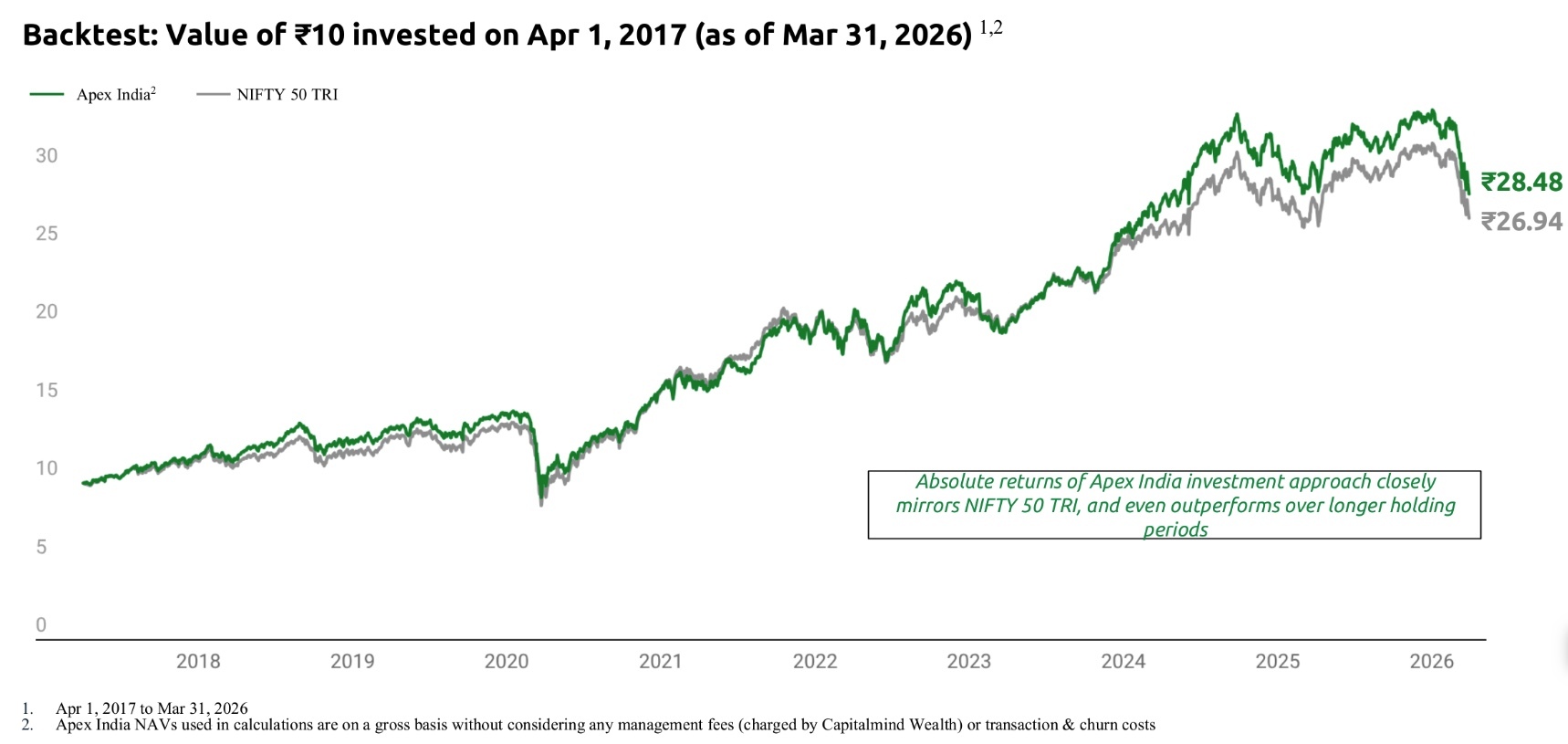
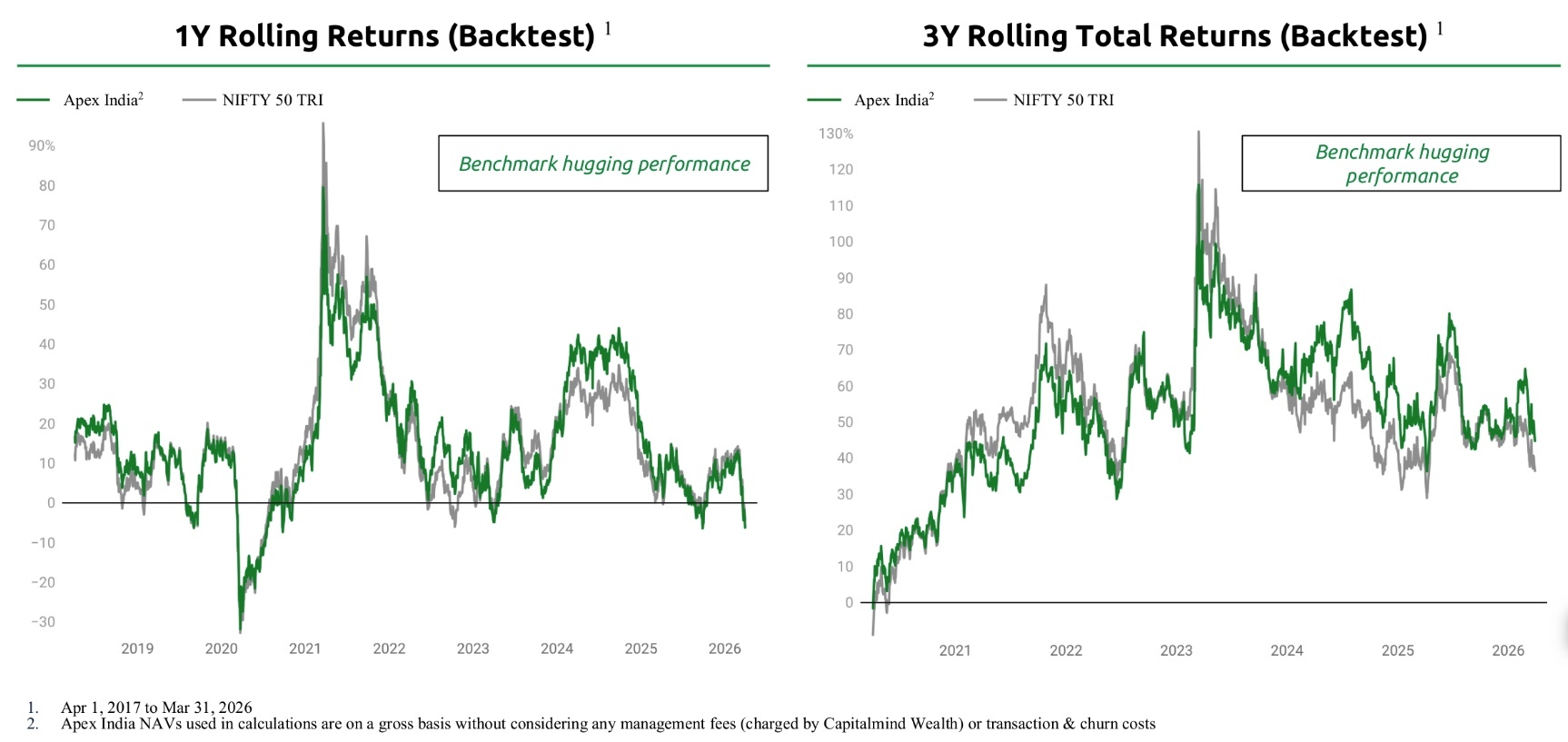
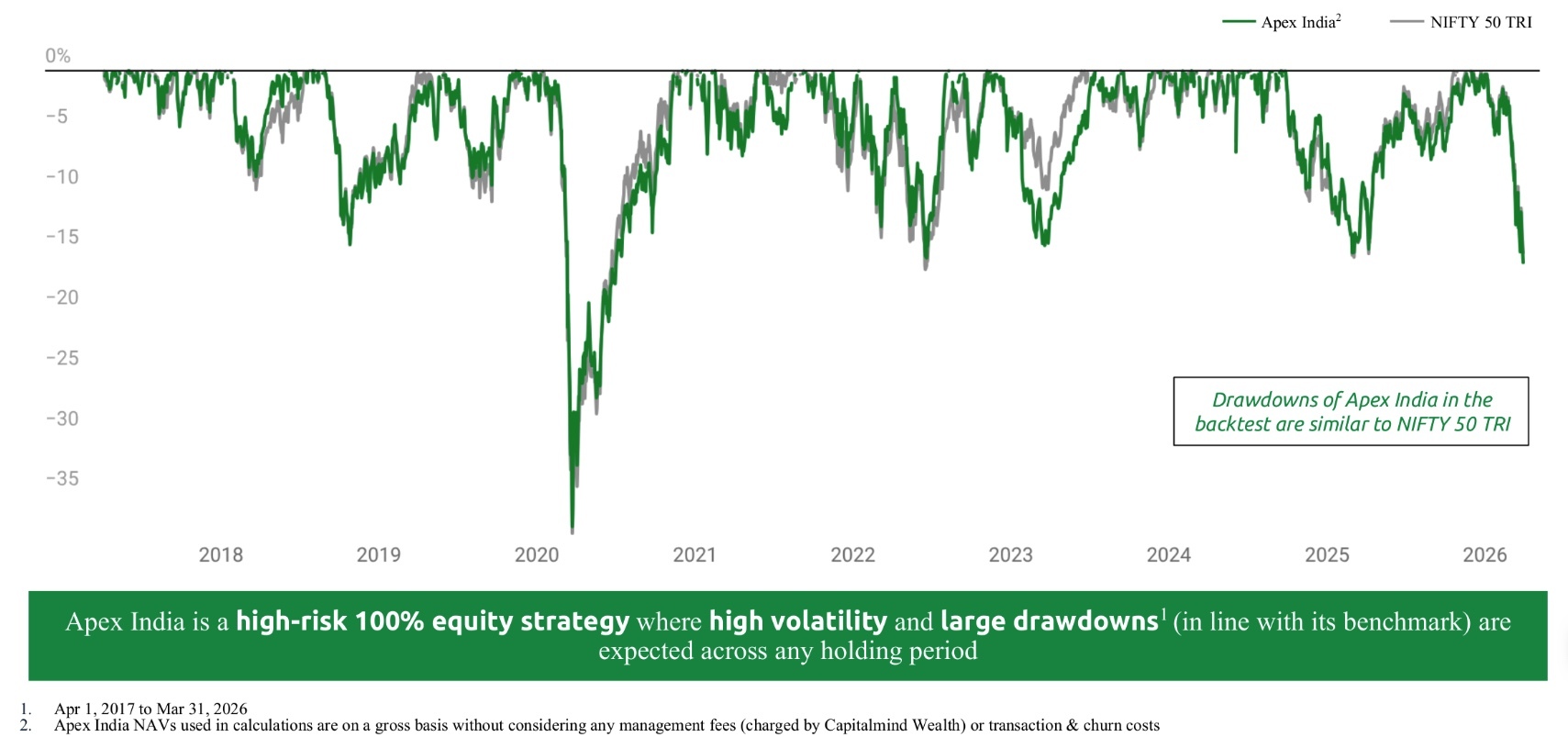
In a backtest from April 2017 to March 2026:
- Rs. 10 in Apex India grew to roughly Rs. 28, compared to the Nifty 50 TRI at Rs. 26
- Rolling 5-year returns averaged 15.7% versus 15.5%
- Volatility and drawdowns sat alongside the benchmark, not against it
The standard disclaimers apply. Backtests can be flattering. The numbers are gross of the management fee and transaction costs. Past performance is not a guide to future performance.
The thing to notice is not the small gap above the index. It is how tightly the two lines run together. Apex India is meant to behave like the Nifty 50, with a small chance of a little extra. If that arrives over a cycle, lovely. If not, the Foundation has carried the portfolio anyway.
Apex and Surge Together: The Whole of India, as Stocks
With both strategies running, an NRI or OCI who is better off not holding mutual funds can get full market-cap exposure to Indian equities through direct stocks alone. Apex India covers the large caps. Surge India mostly covers the mid and small caps. Together, the pair spans the full spectrum of companies driving India's growth, large, mid, and small, with no pooled vehicle anywhere in the structure.
Who is This Right For
If you live in India and are an Indian tax resident, do not buy Apex India. Buy a Nifty 50 index fund. The cost is a few basis points; the exposure is identical. The entire reason Apex India exists is a tax situation you happen not to be in.
If you are an NRI or OCI in a jurisdiction whose tax system treats Indian mutual funds gently like Singapore, Hong Kong, the GCC countries, and a few others, the same answer applies. The fund route is open to you. Use it.
If you are tax-resident somewhere whose tax system treats Indian mutual funds harshly, and you have wanted, for some time, to put money to work in India in the most boring possible way and have not found a vehicle that lets you do that cleanly: this is the vehicle. We built it for you specifically.
In Summary
The reason ordinary investors compound real wealth over long stretches has very little to do with cleverness and almost everything to do with access to an instrument that lets them get out of their own way.
Apex India is an attempt to give that access to NRIs and OCIs whose tax circumstances make the Indian mutual fund version of it impractical. This is not a clever product. It is a boring one, deliberately, because boring is what compounds.
If that is the trade you have wanted to make, this is the route in.
📩 New investors: connect@capitalmindwealth.com 📩 Existing clients: your Relationship Manager, or support@capitalmindwealth.com
Quick facts
- Universe: NSE 100 stocks
- Benchmark: Nifty 50 TRI
- Style: Actively managed, large-cap only
- Number of stocks: ~30 (top 20 by market cap, plus up to 10 in the Edge sleeve)
- Horizon: Minimum 5 years
- Minimum investment: No separate minimum; the standard PMS minimum of Rs. 50 lakh applies across the platform
- Management fee: 1.75% p.a. for NRIs and non-resident OCIs, and 1% for US-resident OCIs
- Performance fee: Nil
- Lock-in / Exit load: Nil
Apex India is an Investment Approach offered by Capitalmind Financial Services Private Limited (SEBI Reg: INP000005847). Investments in securities markets are subject to market risks, including potential loss of principal. Backtested performance is simulated based on model assumptions and does not represent actual client returns. Past performance is not indicative of future results. Read our full disclosure document at capitalmind.in/disclosure#disc-pms and take independent tax and financial advice before investing.
Related Posts
 Where will the Nifty bottom out?
Krishna Appala
 Why High Return on Capital Isn’t Enough: The Key to Long-Term Shareholder Returns
Anoop Vijaykumar
 The Single-Pane-of-Glass Audit: Solving Tax Reporting, Corporate Actions, and Real-Time Capital Gains
Akanksha Maulik
 The Much Awaited Trump Tariffs are Here
Deepak Shenoy
Make your money work as hard as you do.
Talk to a Capitalmind Client AdvisorInvesting is not one size fits all
Learn more about our distinct investment strategies and how they fit into your portfolio.
Learn more about our portfoliosUnlock your wealth potential
Start your journey today